If there's one thing about teaching I'm not very great at (and there are many such things), it's the first day of school. I always struggle with it. I find myself so busy preparing for the year at large, or getting my classroom ready, or whatever else is demanding my attention, that I never really take the time to plan out a really great first day.
In part, I ended up doing what I described (in tongue-in-cheek fashion) to my students as the "time-honored tradition" of going over the syllabus for the first day of class. At one point, one of my administrators walked in to watch my class for a bit, and all they saw was me going over the syllabus. It was one of those "please just kill me now" moments for me.
I'm being over-dramatic, though. It really wasn't so bad. I'm really looking forward to working with the group of seniors I have this year, and I enjoyed meeting them today. I definitely did a lot of talking, which I never prefer to do, but it'll be different tomorrow.
As part of the first day of class, I had my students fill out a survey about how confident they feel about their math skills, what "doing math" means to them, and what they hope they'll have learned by the end of the course. The first three questions were Likert scale items. Here are some of the numbers:
1. How confident are you in your ability to "do math"?
Completely confident: 11/78
Mostly confident: 31/78
Somewhat confident: 22/78
A little confident: 6/78
Not at all confident: 8/78
2. How confident are you in your ability to talk about math verbally using mathematical reasoning and vocabulary?
Completely confident: 5/78
Mostly confident: 16/78
Somewhat confident: 31/78
A little confident: 14/78
Not at all confident: 12/78
3. How confident are you in your ability to communicate about math in writing?
Completely confident: 7/78
Mostly confident: 14/78
Somewhat confident: 36/78
A little confident: 18/78
Not at all confident: 5/78
Overall, my students this year seem to be carrying a healthy level of confidence in their ability to "do math." (Of course, that depends on their definition of what it means to "do math," which I asked later on.)
There's a considerable split in confidence with my students as far as communicating mathematically. Those are two areas I intend to focus on this year: I want my students to speak and write confidently about mathematics. I want them to be well-versed in the Math Practice Standards by the end of the course.
There were some other short answer questions. There are too many responses to list, so I just picked a few examples that I think give the general view of the students:
4. What do you think it means to "do math?"
"I think it means solving problems with numbers. Doing math is when you work out a math problem. Also taking time to make sure your answer is right."
"To do math is understanding the logic behind a problem. It is the ability to explain problems to others verbally and on paper. Doing math is using more than one technique to find the correct answers."
"I believe that 'doing math' is thinking about a problem critically and using certain formulas to find out the answer to something."
"To do math is to find the answer to a problem that involves numbers, distances, functions, or any form of measurement. A math problem usually has a set number of answers that have to be found through use of mathematical functions or equations. But to do math is to use logic to solve something."
"Doing math means to completely understand it, and for me that comes in 3 parts. Before you can properly plug in numbers to equations, you must first know what those equations mean, and what answer(s) they are trying to achieve. After knowing that, you must know how to correctly plug in the numbers in the equation to get your answer. The final thing that you need to know how to do when 'doing math' is being able to explain what you did, and why. If you are not able to explain how or why you did what you have done, then there is no way to tell if you were right in your thinking."
"'Do math' to me means to solve a puzzle. You need to find all the pieces of the puzzle in order to solve the problem."
"To 'do math' is to have an answer to the problem presented. However, I think that 'doing math' also includes the full understanding of the problem. Also being confident in the answer that you have."
5. What does it mean to be a "good mathematician?"
"Math is easy to learn but hard to master. Given enough time, anyone can solve any problem. Being a good mathematician means being able to solve equations in a quick manner."
"Being a good mathematician means that you can easily identify and solve problems quickly and correctly."
"A good mathematician doesn't give up easily, but keeps trying different methods until the problem can be solved. A good mathematician learns to apply conclusions to the world surrounding him or her."
"A good mathematician is not necessarily someone that finds answers quickly, but rather one that finds answers effectively."
"A good mathematician is someone who can answer the problem that they have set in front of him or her. They can execute the best possible method of doing a problem, in the quickest way possible. They also understand all of the math behind it."
"A good mathematician would use... nothing other than your brain. Wouldn't use a calculator and know every function in math. Be like Albert Einstein."
"Being good at math means being able to remember formulas and solve problems quickly. I also think it means being able to help anyone when they need help during a certain area they don't quite understand."
"To be a good mathematician means you have a brain like a computer. If someone asks you a difficult math question you should be able to answer it in a matter of seconds."
"A good mathematician would know how to recognize a math problem. A good mathematician would actively seek answers to things he/she doesn't understand. Finally a good mathematician knows and studies deeply the subject of math."
6. What do you hope you will have LEARNED in Pre-Calculus by the end of the school year?
"I want to learn how to solve math problems in the quickest ways possible. I also want to explore different forms of calculators and their functions."
"I hope at the end of the year I learn how to solve my problems, without errors or depending on anyone for help."
"Pre-Calculus should teach students more advanced forms of mathematics, past the formulas and equations. Pre-Calc is a dreaded class by some, but can be helpful in certain professions."
"I really want to know how some advanced math could be used to solve everyday problems, so if it is just the same old stuff revisited from last year at least show us how it applies to real life."
"I honestly just hope to learn something new in Pre-Calculus. I want more challenging problems so I can have more math skills."
"A way to understand Calculus without being a mindless zombie to the textbook. Well, understand enough to understand college Calculus."
"I hope that I have learned new formulas and learned them well."
"Hopefully I will be able to pass."
"I hope that I will have learned to explain my reasoning with most of my math problems, thus broadening my horizon on how to be a good teacher."
7. What do you hope you will have EXPERIENCED in Pre-Calculus by the end of the school year?
"I hope to experience an even greater understanding of math as well as enjoy it more. It's currently my favorite subject, so I believe that most, if not all, of my experiences will be positive in this class."
"I hope that I will experience how to speak mathematics in a different kind of language than what I usually use when I explain a solution to a problem."
"Uhm, what am I SUPPOSED to have experienced? I don't really have any hope for anything in this class."
"By the end of the year I hope to have experienced how to deal with stress when it comes to math. Math has always been my worst subject and I get stressed a lot while doing math."
"I hope to experience new things and different ways of solving problems."
"I really don't know. Surprise me."
"I hope to experience what it will be like to use math in the real world, such as: taxes, sales, etc."
"I hope to have experienced the questions that make you sweat, and look back in your notes to figure out. I love puzzles and math and I love a challenge so I want to experience a good challenge in a math course. I want to be able to help others with their homework and also be able to say I had the best Pre-Calc teacher in high school history." (Geez, no pressure there, right?)
While I definitely don't think this first day of school was the greatest, I did end up getting a lot of really thoughtful responses to these questions (again, way too many to list). The attitudes and views of my students towards math definitely cover a wide spectrum this year. I'm really encouraged by the number of students who said they're craving challenge. I love it. I hope I can deliver.
We're starting a group task by the end of the week. I'm going to try grouping students so that each group member has a certain level of confidence in talking about math, writing about math, or just doing math. I may also group them by how they responded to the written questions. We'll see how it goes.
It will be interesting to see how the students answer these questions in May. I hope that more of them will see "doing math" in terms of problem-solving, constructing arguments, modeling, looking for structure, and so on.
And so a new school year begins. Allons-y!

Education, math, project-based learning, other stuff, and possibly ninjas.
Showing posts with label students. Show all posts
Showing posts with label students. Show all posts
Wednesday, August 27, 2014

Tuesday, October 22, 2013
Two Things From a Tuesday
Or maybe I should title this post "Twosday Things." Because I like portmanteaus.
Thing #1:
Today, I was talking one-on-one with a student about functions. We were talking about the relationship between domain and range, and how to tell if two sets of values make up the domain and range of a function. We talked about how values in the domain are each assigned to one and only one value in the range by the function. I chimed in with the "mailbox analogy" to further explain the relationship: say you're mailing a bunch of letters. The stack of letters is like the domain, and the houses the letters are being mailed to are like the range. You can mail multiple letters to the same house, but you can't mail the same letter to multiple houses. "So you can't mail the same letter to Chicago, New York, and San Francisco simultaneously," I said to the student.
"Unless it's e-mail," the student replied.
HOLY CRAP. That was a really, really good point! I was utterly stunned that I hadn't thought of that. I guess the analogy kind of breaks down in that regard if you throw e-mail into the mix. I'm still pretty sure I got my point across, but it does have me thinking about the analogy I'm using to describe how functions work. Will this be an outdated analogy in the near future?
Either way, I was super-impressed by my student today.
Thing #2:
Some of my students are currently working on compound inequalities. Below is a piece of student work that I found interesting:

The left side of the compound inequality vanished! I've actually been seeing this happen with several students in my class; every time they get one side of a compound inequality equal to zero, they omit it in the rest of their work.
I've been wondering where this is coming from. I imagine it might have something to do with the fact that students are sometimes taught about the existence of an "implied" zero that isn't actually shown. (For example, what is the slope of the line y = 2? There's no x-term, but there's an implied "0x" in the equation; thus, y = 0x + 2, and the line has a slope of 0.)
Maybe it's coming from somewhere else. I don't think it's anything I've done, but I could be wrong.
Anyway, that's two things from a Tuesday. Maybe I'll try to do this weekly, so I'm blogging more often.
Thing #1:
Today, I was talking one-on-one with a student about functions. We were talking about the relationship between domain and range, and how to tell if two sets of values make up the domain and range of a function. We talked about how values in the domain are each assigned to one and only one value in the range by the function. I chimed in with the "mailbox analogy" to further explain the relationship: say you're mailing a bunch of letters. The stack of letters is like the domain, and the houses the letters are being mailed to are like the range. You can mail multiple letters to the same house, but you can't mail the same letter to multiple houses. "So you can't mail the same letter to Chicago, New York, and San Francisco simultaneously," I said to the student.
"Unless it's e-mail," the student replied.
HOLY CRAP. That was a really, really good point! I was utterly stunned that I hadn't thought of that. I guess the analogy kind of breaks down in that regard if you throw e-mail into the mix. I'm still pretty sure I got my point across, but it does have me thinking about the analogy I'm using to describe how functions work. Will this be an outdated analogy in the near future?
Either way, I was super-impressed by my student today.
Thing #2:
Some of my students are currently working on compound inequalities. Below is a piece of student work that I found interesting:

The left side of the compound inequality vanished! I've actually been seeing this happen with several students in my class; every time they get one side of a compound inequality equal to zero, they omit it in the rest of their work.
I've been wondering where this is coming from. I imagine it might have something to do with the fact that students are sometimes taught about the existence of an "implied" zero that isn't actually shown. (For example, what is the slope of the line y = 2? There's no x-term, but there's an implied "0x" in the equation; thus, y = 0x + 2, and the line has a slope of 0.)
Maybe it's coming from somewhere else. I don't think it's anything I've done, but I could be wrong.
Anyway, that's two things from a Tuesday. Maybe I'll try to do this weekly, so I'm blogging more often.
Tuesday, October 8, 2013
Multiple Solutions (A follow-up to "When Is the Right Answer the Right Answer?")
A couple of weeks ago, I wrote this post about how I wanted my students to determine equations of lines, given certain information. The broader point, I think, was realizing that my students had more than one option for determining answers to the problems they were working on, and being okay with that. (Why wouldn't I be?)
I had another "when is the right answer the right answer?" moment in class yesterday that I thought was really super-cool.
Two students were working together on the same problem. They came up with what they thought were different answers, so they were wondering who was correct. Their work is shown below:


So both students used point-slope form for their equations, and came up with two answers that looked different. This peculiarity made them wonder who was right and who was wrong. (Which, in turn, makes me realize that I still have a lot of work to do with teaching them about making sense versus being right.) They called me over to ask me who had the correct equation.
I must have been really busy at that moment and not really thinking, because I looked at their answers and said, "actually, you're both right." Not that I was wrong in saying so; but I regret that I didn't recognize the teachable moment that had presented itself. This would have been a great opportunity to ask each of them what they thought about their equations, how they came up with them, why they thought their answers made sense, why the other person got something different, and whether or not it made a difference which point they used for point-slope form. Still, it was a really cool moment: two students have a spirited debate over who had the "right" equation, when really they were both right. It was my favorite moment of class from yesterday.
Fortunately, the same thing happened today, on the same problem, with the same work as shown above, between a different pair of students. Grateful for a second chance, I was able to stop and facilitate an awesome math discussion between the two of them.
One student was adamant that the "first" point, (-4, 3), had to be plugged in for point-slope form instead of the "second" point, "because they're X1 and Y1," she reasoned. She said this because she had labeled the coordinates as such when using the slope formula to determine the slope:

And point-slope form was written on the board as Y - Y1 = (X - X1). So I could see where she was coming from.
I asked her, "so, how would you label these points if the order was swapped?" In other words, what if the problem listed the points "(6, 1) and (-4, 3)" instead of the order they were given? She responded that she would have labeled (6, 1) as (X1, Y1) and (-4, 3) as (X2, Y2).
My next question was, "So would that change things? Would you get a different slope, for instance?" The student initially thought that yes, she would get a different slope. The other student, who was working with her, said that the slope should be the same. I had both of them determine the slope of the line with the different designations for the coordinates; naturally, the slopes turned out to be the same as in their original work.
I asked, "how did changing the order of the points affect the slope?" The student replied that the order of the points didn't change the slope at all. "Cool," I said. "So what about the two different equations you guys came up with? What difference does choosing one point over the other [when plugging a point into point-slope form] make?" The first student still wasn't quite convinced that it didn't matter what point she chose; her partner said it didn't matter what point was chosen for the point-slope form of the equation.
We decided to have each of them solve their equations for y, so they'd both be in slope-intercept form. When they did so, they came up with the same equation, and the first student was finally convinced that it didn't matter which of the two points she chose. Both students were convinced that they'd both determined correct equations for the line described in the problem. "Why doesn't it matter which point you choose?" I asked. The first student wasn't quite sure. The second student guessed, "because both points are on the same line?" I replied, "that sounds like it makes sense."
I love when students find different (yet equally valid) solutions to problems like this. It makes for some great discussion. I need to keep myself aware that it's more important to ask my students to make sense of their work instead of telling them that they're right; I missed out on having a great conversation with two students yesterday, but I'm glad I had another chance at it today.
I had another "when is the right answer the right answer?" moment in class yesterday that I thought was really super-cool.
Two students were working together on the same problem. They came up with what they thought were different answers, so they were wondering who was correct. Their work is shown below:


So both students used point-slope form for their equations, and came up with two answers that looked different. This peculiarity made them wonder who was right and who was wrong. (Which, in turn, makes me realize that I still have a lot of work to do with teaching them about making sense versus being right.) They called me over to ask me who had the correct equation.
I must have been really busy at that moment and not really thinking, because I looked at their answers and said, "actually, you're both right." Not that I was wrong in saying so; but I regret that I didn't recognize the teachable moment that had presented itself. This would have been a great opportunity to ask each of them what they thought about their equations, how they came up with them, why they thought their answers made sense, why the other person got something different, and whether or not it made a difference which point they used for point-slope form. Still, it was a really cool moment: two students have a spirited debate over who had the "right" equation, when really they were both right. It was my favorite moment of class from yesterday.
Fortunately, the same thing happened today, on the same problem, with the same work as shown above, between a different pair of students. Grateful for a second chance, I was able to stop and facilitate an awesome math discussion between the two of them.
One student was adamant that the "first" point, (-4, 3), had to be plugged in for point-slope form instead of the "second" point, "because they're X1 and Y1," she reasoned. She said this because she had labeled the coordinates as such when using the slope formula to determine the slope:

And point-slope form was written on the board as Y - Y1 = (X - X1). So I could see where she was coming from.
I asked her, "so, how would you label these points if the order was swapped?" In other words, what if the problem listed the points "(6, 1) and (-4, 3)" instead of the order they were given? She responded that she would have labeled (6, 1) as (X1, Y1) and (-4, 3) as (X2, Y2).
My next question was, "So would that change things? Would you get a different slope, for instance?" The student initially thought that yes, she would get a different slope. The other student, who was working with her, said that the slope should be the same. I had both of them determine the slope of the line with the different designations for the coordinates; naturally, the slopes turned out to be the same as in their original work.
I asked, "how did changing the order of the points affect the slope?" The student replied that the order of the points didn't change the slope at all. "Cool," I said. "So what about the two different equations you guys came up with? What difference does choosing one point over the other [when plugging a point into point-slope form] make?" The first student still wasn't quite convinced that it didn't matter what point she chose; her partner said it didn't matter what point was chosen for the point-slope form of the equation.
We decided to have each of them solve their equations for y, so they'd both be in slope-intercept form. When they did so, they came up with the same equation, and the first student was finally convinced that it didn't matter which of the two points she chose. Both students were convinced that they'd both determined correct equations for the line described in the problem. "Why doesn't it matter which point you choose?" I asked. The first student wasn't quite sure. The second student guessed, "because both points are on the same line?" I replied, "that sounds like it makes sense."
I love when students find different (yet equally valid) solutions to problems like this. It makes for some great discussion. I need to keep myself aware that it's more important to ask my students to make sense of their work instead of telling them that they're right; I missed out on having a great conversation with two students yesterday, but I'm glad I had another chance at it today.
Monday, October 7, 2013
Taking a Teaching Mulligan
Sometimes, despite trying to do my best job possible as a teacher, I screw up. I'm pretty sure it's healthy to accept that it happens from time to time.
A few weeks ago, my students took a quiz that pretty much nobody did well on. Like, not even really that close. (I'm not going to go into what the subject matter was or how my lessons were designed or what scaffolding I did -- that doesn't really pertain to the message of my post today.)
Needless to say, this elicited an emotional reaction from me. I actually had to stop grading and walk away for a few minutes because I was feeling a mix of sadness and anger all at once. I reasonably sure that I was uttering curse words under my breath after I came back and continued grading.
I think, unfortunately, there are some teachers who probably would have taken that anger and directed it at their students the next class period. I've seen teachers get absolutely pissed off at their students for doing terribly on a quiz or a test as a whole group.
I'm not one of those teachers. When students don't perform well on an assessment, I blame myself. I blame myself pretty hard, actually. Maybe more than I should. I guess I can't help it.
This happened on a Friday afternoon. I thought about what to do all weekend. I came back to my students on Monday and, in each class, just laid it out for them:
"Guys, nobody did well on this quiz. I'm sorry. I blame myself for that. When nobody does well, that tells me that I probably did something wrong with my teaching. So, I'm not going to include these quizzes in your grade for now. We'll come back to it next week, I'll try to teach differently, and we'll re-take this quiz. Does that sound fair?"
And it sounded fair to everyone.
I imagine part of why my students were amenable to this is because many of them sensed that they hadn't done well. I bet many of them were afraid they'd let me down, or that I was going to be mad at them for failing one silly math quiz. They probably don't know that, when a class bombs an assessment, the first question I always ask myself is, "what did I do wrong?"
Stuff like this is a humbling reminder that, even though I work hard and try my very best as an educator, there will be times where I come up short. I try to keep those instances few and far between, but from time to time it will happen. When it does, I think the right thing is to give my students a second chance -- or, more accurately, ask my students to give me a second chance.
A few weeks ago, my students took a quiz that pretty much nobody did well on. Like, not even really that close. (I'm not going to go into what the subject matter was or how my lessons were designed or what scaffolding I did -- that doesn't really pertain to the message of my post today.)
Needless to say, this elicited an emotional reaction from me. I actually had to stop grading and walk away for a few minutes because I was feeling a mix of sadness and anger all at once. I reasonably sure that I was uttering curse words under my breath after I came back and continued grading.
I think, unfortunately, there are some teachers who probably would have taken that anger and directed it at their students the next class period. I've seen teachers get absolutely pissed off at their students for doing terribly on a quiz or a test as a whole group.
I'm not one of those teachers. When students don't perform well on an assessment, I blame myself. I blame myself pretty hard, actually. Maybe more than I should. I guess I can't help it.
This happened on a Friday afternoon. I thought about what to do all weekend. I came back to my students on Monday and, in each class, just laid it out for them:
"Guys, nobody did well on this quiz. I'm sorry. I blame myself for that. When nobody does well, that tells me that I probably did something wrong with my teaching. So, I'm not going to include these quizzes in your grade for now. We'll come back to it next week, I'll try to teach differently, and we'll re-take this quiz. Does that sound fair?"
And it sounded fair to everyone.
I imagine part of why my students were amenable to this is because many of them sensed that they hadn't done well. I bet many of them were afraid they'd let me down, or that I was going to be mad at them for failing one silly math quiz. They probably don't know that, when a class bombs an assessment, the first question I always ask myself is, "what did I do wrong?"
Stuff like this is a humbling reminder that, even though I work hard and try my very best as an educator, there will be times where I come up short. I try to keep those instances few and far between, but from time to time it will happen. When it does, I think the right thing is to give my students a second chance -- or, more accurately, ask my students to give me a second chance.
Monday, August 5, 2013
"When Am I Ever Going to Use This?" ...Sometimes I Don't Know the Answer
For some reason, the question of "when am I ever going to use this in real life?" seems to pop up at a disproportionately higher rate in math class than in any other subject. I'm willing to bet that's the case.
Do I have any scholarly research or statistics to back up this claim? No.
But I did go to Google and type in the phrase, "when am I ever," to see what popped up:
 See? Algebra and Calculus! Obvious proof that this question is asked more in math class than in any other class! And if you aren't convinced by this, then... uh... um... well, then you probably think critically about your info sources and have good judgment.
At any rate, the new school year is around the corner. I've enjoyed the time away from the classroom and have spent many hours mapping curriculum, trying to keep up with the happenings in the MTBoS and preparing some new tasks to try out this year.
As I was reflecting on my first four years of teaching and looking ahead to year five, I kept thinking about what I'm going to do when, inevitably, the question is asked:
"When am I ever going to use this kind of math in real life?"
This question nearly always evokes some kind of emotional reaction from me. One of two types, in fact:
(1) UNADULTERATED, ABSOLUTE JOY, because I have an answer to the question that is totally satisfactory, underscores the relevance of the current mathematical topic, lets me talk about math (which is super-cool because I love talking about math) and helps the kid to see just how motherfreaking awesome math is,
or
(2) MURDEROUS RAGE that someone, who's half my age, who hasn't even learned as much math as I've forgotten, would have the impudence to ask me that question. Not just to ask me that question, but to ask me that question when I have no idea whatsoever how to answer in a way that isn't complete bullcrap.
Okay, I don't actually get mad at students for asking me that question. Or any question. Not ever. I like having curious students. And a job.
I do try my best to be prepared to answer the question of "when am I going to use this?" for any mathematical topic that comes up in my classroom. But sometimes I do feel annoyed when I don't really have a good answer. Not annoyed at the student (not much, anyway), but more at myself for not being prepared with a brilliant, insightful response. After all, I'm the math teacher, right? I should know, in great detail, when the hell someone would ever use an inverse tangent function when they get out into the real world. I should be able to spell out the exact situation in which one would need to know everything there is to know about the latus rectum. (Tee-hee.)
But I don't always know the answer. When that happens -- depending on my mood/how busy I am/what's happening in class/how many cups of coffee I've consumed in the past five minutes -- I tend to go with one of the following responses (I don't recommend using any of these):
I feel terrible when I don't have an answer for that question right away. There are times when it seems like it would be easiest just to say, "you know, there's a pretty good chance that you're not actually going to use this; but hey, gotta know it to pass, right?"
I mean, I've actually uttered those words to a student once or twice. I'm not proud of it. At the time, I felt like I was just being straight with the kid(s) who asked. I guess I figured that kids appreciate honesty and have a pretty good nose for B.S. But when I think about it, I realize that what I really did was cheat those students out of a great learning opportunity. I cheated myself as well.
I'm a math teacher, yes, but I'm also a math learner. A lifelong math learner. I shouldn't be ashamed or annoyed when I don't know exactly where or when stuff like hyperbolas or the mean value theorem are used in real life. Instead, I should be seeing an opportunity to learn something new. I should be excited that I've discovered something new to learn about a topic I absolutely love. I should be, like, absolutely jacked that there's stuff about math that I don't know but can find out about for myself. I mean, that's what I'd want my students to do, right?
So this year, I'm going to start using this response (or something similar, still a work in progress):
I'm a math teacher; I shouldn't be shrinking away from that question when a student comes asking. I should be full-on body tackling that thing like it's a quarterback's blind side.
I do think we math teachers try to know where the stuff we teach can be used in the world beyond school; but we won't always know. When we don't know, we need to find out. We need to include our students in the process of finding out, because they asked the question in the first place.
We can't always know, but we can always care. We can always care enough to try and find out. We can always care enough to try and do better.
So this year, I'll try and do better.
Do I have any scholarly research or statistics to back up this claim? No.
But I did go to Google and type in the phrase, "when am I ever," to see what popped up:

At any rate, the new school year is around the corner. I've enjoyed the time away from the classroom and have spent many hours mapping curriculum, trying to keep up with the happenings in the MTBoS and preparing some new tasks to try out this year.
As I was reflecting on my first four years of teaching and looking ahead to year five, I kept thinking about what I'm going to do when, inevitably, the question is asked:
"When am I ever going to use this kind of math in real life?"
This question nearly always evokes some kind of emotional reaction from me. One of two types, in fact:
(1) UNADULTERATED, ABSOLUTE JOY, because I have an answer to the question that is totally satisfactory, underscores the relevance of the current mathematical topic, lets me talk about math (which is super-cool because I love talking about math) and helps the kid to see just how motherfreaking awesome math is,
or
(2) MURDEROUS RAGE that someone, who's half my age, who hasn't even learned as much math as I've forgotten, would have the impudence to ask me that question. Not just to ask me that question, but to ask me that question when I have no idea whatsoever how to answer in a way that isn't complete bullcrap.
Okay, I don't actually get mad at students for asking me that question. Or any question. Not ever. I like having curious students. And a job.
I do try my best to be prepared to answer the question of "when am I going to use this?" for any mathematical topic that comes up in my classroom. But sometimes I do feel annoyed when I don't really have a good answer. Not annoyed at the student (not much, anyway), but more at myself for not being prepared with a brilliant, insightful response. After all, I'm the math teacher, right? I should know, in great detail, when the hell someone would ever use an inverse tangent function when they get out into the real world. I should be able to spell out the exact situation in which one would need to know everything there is to know about the latus rectum. (Tee-hee.)
But I don't always know the answer. When that happens -- depending on my mood/how busy I am/what's happening in class/how many cups of coffee I've consumed in the past five minutes -- I tend to go with one of the following responses (I don't recommend using any of these):
- "That's a great question." *flees without saying another word*
- "I can't tell you that; it would ruin the surprise!"
- "'Real life?' Math is real life, son."
- "You know, I find that the best answers in life are the ones we find for ourselves."
- "What're you talking about? I use it all the time!" ("But you're a math teacher," the student replies. "Yep, that's why I use it all the time!" I reply back.)
- "Uh, come see me after class and I'll be happy to talk to you more about your question." (Nobody has ever taken me up on this.)
I feel terrible when I don't have an answer for that question right away. There are times when it seems like it would be easiest just to say, "you know, there's a pretty good chance that you're not actually going to use this; but hey, gotta know it to pass, right?"
I mean, I've actually uttered those words to a student once or twice. I'm not proud of it. At the time, I felt like I was just being straight with the kid(s) who asked. I guess I figured that kids appreciate honesty and have a pretty good nose for B.S. But when I think about it, I realize that what I really did was cheat those students out of a great learning opportunity. I cheated myself as well.
I'm a math teacher, yes, but I'm also a math learner. A lifelong math learner. I shouldn't be ashamed or annoyed when I don't know exactly where or when stuff like hyperbolas or the mean value theorem are used in real life. Instead, I should be seeing an opportunity to learn something new. I should be excited that I've discovered something new to learn about a topic I absolutely love. I should be, like, absolutely jacked that there's stuff about math that I don't know but can find out about for myself. I mean, that's what I'd want my students to do, right?
So this year, I'm going to start using this response (or something similar, still a work in progress):
- "You know what? I'm not quite sure. I know there's a use for [insert mathematical concept here], but I'm still trying to figure that out. I'll try to do some research on it after class. Maybe you could also look it up, and let me know what you find. That would be really helpful."
I'm a math teacher; I shouldn't be shrinking away from that question when a student comes asking. I should be full-on body tackling that thing like it's a quarterback's blind side.
I do think we math teachers try to know where the stuff we teach can be used in the world beyond school; but we won't always know. When we don't know, we need to find out. We need to include our students in the process of finding out, because they asked the question in the first place.
We can't always know, but we can always care. We can always care enough to try and find out. We can always care enough to try and do better.
So this year, I'll try and do better.
Sunday, July 28, 2013
BATTLESHIP! - Graphing Equations of Circles
I've been dying to incorporate more PrBL tasks into my classroom. For the past couple of years, our math team spent a huge deal of time and energy on a complete overhaul of our four-year math curriculum in order to more strongly align it with ACT College Readiness Standards. It was certainly a worthwhile endeavor; I'm very proud of what our awesome math team has accomplished, and I think our students will greatly benefit from what we've done so far.
At the same time, this pretty much meant I had zero time to work on any PrBL stuff, especially with moving from teaching Geometry to teaching Pre-Calculus at the same time. However, our project was finally completed this past spring, so I have been happily spending the summer working on PrBL-related curriculum mapping for my Pre-Calculus and Advanced Pre-Calculus classes.
(Yes, I just said "happily" and "curriculum mapping" in the same sentence.)
Below is one PrBL task that I've been working on for a graphing unit this school year. I think (and hope) the students will have fun with it; it's not particularly all that "real-worldy," and it definitely needs refinement, but I gotta start somewhere. Of course, as with anything I haven't tried in class yet, it's a work in progress.
This task involves understanding and graphing equations of circles. I call it: BATTLESHIP!

The Scenario: You are the commander of a mighty naval fleet in the middle of international waters. The enemy has developed a new type of submarine known as a Hyperbolic Invisibility/Deep Dive ENgine, or a H.I.D.D.EN. submarine.
The enemy's H.I.D.D.EN. submarines are capable of avoiding nearly all types of radar detection. In fact, you are only able to determine the distance a H.I.D.D.EN. submarine is from any of your naval stations.
Your task is to devise a way to pinpoint the exact location of a H.I.D.D.EN. submarine. Succeed, and your forces will be able to destroy the enemy fleet. Fail, and you're doomed. DOOMED!
(If you couldn't tell, I have an affinity for silly acronyms.)
The Entry Event: Before things really kick off, I'll give the students a few warm-up problems to assess and activate their prior knowledge. Students will need to know the parts of a circle (particularly the radius and the center), and will also need to be able to re-write a two-variable equation (i.e. solve for y in terms of x). The latter will be important for graphing circles on most graphing utilities.
To introduce the problem, I'll present the following situation to students on Activeprompt:
"You are the commander of a naval station, shown here on the grid. An enemy submarine is approaching.
The submarine has a cloaking device that hides its exact location from your radar system. However, you are still able determine how far away the submarine is from the station.
The submarine is 5 miles away from the station. Where is it?"

I posted this prompt on Twitter, and a couple of my friends immediately pointed out that they couldn't answer the question because they didn't know which direction the submarine was from the station. This is true, and in many ways is actually the point of this prompt; I suppose I should be more clear that I want students to guess where the submarine might be, and that I'm not necessarily looking for "the correct answer" at this stage.
Still, I had several responses to the prompt and ended up with something I would hope to see in class:

Hopefully, students will take one look at this picture and notice the pattern: there appears to be a circle forming around the station. At this point, students can take some time to think about further questions: Why is there a circle? What does this circle mean? What can we figure out about this circle? What does this circle have to do with finding the submarine?
After discussion, the hope is that students would come to the following conclusions:
Need-to-Knows & Scaffolding: While I'm sure that my students will surprise me (students have a habit of doing that), the need-to-know that should be immediately apparent is: "How do we locate the submarine?" In fact, we begin the process of answering this question with the entry event.
Again, one of the key realizations from the entry event is that all of the possible locations of the submarine are represented by a circle, radius 5, with the naval station as its center:

A good follow-up question would be, "How do we narrow down the number of possible locations?" The answer may or may not be readily apparent. I'd encourage students to think outside the box -- or perhaps, more appropriately, "think outside the circle."
Because we could narrow down the number of possible locations if we had a second naval station. Say, at coordinates (7, -8). And it detects the submarine at a distance of 7 miles.
 Aha! Just like that, we've narrowed our possible locations down to two; namely, the two points (1 and 2) where the circles intersect each other. (It certainly wouldn't hurt to have the students explain why these are the only two places the submarine could be.)
From here, it probably won't be a huge leap for the students to realize that adding a third naval station will narrow our choices down to just one. We'll get back to that in a moment.
A critical issue arises from this new picture: while Point 2 clearly appears to be located at the coordinates (7, -1), it's much less clear what the coordinates of Point 1 are. This should lead to another question: "How do we accurately determine the coordinates of the point(s) where the circles intersect?"
Now, this part of the task is a bit murky for me. It's not all that difficult to come up with a good estimate of Point 1's coordinates using Geometer's Sketchpad, but the point of the task is for students to work with and understand equations of circles. To this end, I want students to be working with a graphing utility (e.g. TI-83/84) as we address this question. So, yeah... if anyone has a good suggestion for how to make sure it steers in that direction, I'm all ears!
In any case, turning to our graphing calculators should bring up the question: "How do we graph circles?" The best way to do this with our graphing calculators (or an online tool like Desmos) would be to input an equation. That, of course, leads to: "What's the equation for a circle?"
At this point, appropriate scaffolding activities and workshops could be used to help students understand how to determine the equation of a circle, given the center and the radius. I'd probably also give students a few practice problems to give them some exercise in this skill. When using a graphing calculator like a TI-83 or TI-84, students would also need to know how to re-write their circle equations for y in terms of x so they can actually enter them. (This would be one advantage of using Desmos over a graphing calculator; such a conversion isn't necessary. On the other hand, re-writing equations would also be a great chance to talk about issues such as positive and negative roots, for instance.)
Since I don't have the proper software readily available for getting some clear TI-83 screenshots, here are the two circles graphed on Desmos:

On a TI graphing calculator, students could use a combination of ZOOM and TRACE to estimate the coordinates of Point 1. CALC -> INTERSECT would also be a good option. On Desmos, we can just click on the intersection point to get an estimate of the coordinates:
 If we want greater accuracy, we can zoom in really close:

Using CALC -> INTERSECT on my TI-83 yielded an estimate of (3.4461538, -1.969231), so very similar results. If we rounded to the nearest hundredth, we can pretty solidly estimate the coordinates of Point 1 to be (3.45, -1.97). (It might be interesting to have students estimate the coordinates of Point 1 prior to using their graphing utilities to see how close they came by just "eyeballing" it.)
Of course, we said much earlier that we need three stations to determine where the submarine is. We could introduce the third station much earlier in the problem, or we could hold off until now to introduce it.
So, let's say the third station is located at (-5, 4) and detects the submarine at a range of 13 miles. Students determine the equation of the circle with this center and radius, enter it into their graphing utility, and voila:

So our enemy submarine is located at coordinates (7, -1). Huzzah!
Applying the Learning: Now, I wouldn't have gone through the whole business of figuring out how to estimate coordinates using a graphing utility if the solution was always going to be as simple as (7, -1). For something more challenging that definitely requires the assistance of a graphing utility, let's say we have the following information:
Would You Like to Play a Game?: For something really fun at the end of this problem, we would turn our scenario into a war game. I would break the students up into teams of two or three; each team gets one H.I.D.D.EN. submarine and three naval stations. Teams get to place their submarine and naval stations at whatever coordinates they choose (within certain borders, of course).
After all submarines and stations are placed, I provide each team with information about how far away each enemy submarine is located from their stations. (This adds a layer of complexity to the original problem scenario, as teams now have information about multiple submarines and they have to mix & match circles in order to pinpoint them all.) The teams then race against each other to try and be the first to locate and destroy the other submarines. Winning team gets riches and glory. Well, just glory. Not much glory.
Final Thoughts: In the end, I thought this task seemed like a fun way for students to learn about how to graph equations of circles and then apply that skill.
Hopefully, when the students share out what they learned as a result of this problem, they'll be able to articulate a deep understanding of the relationship between circles, their equations, and their graphs. It'd also be cool if some of them see the connections between equations of circles and the Pythagorean Theorem or the Distance Formula. I certainly hope they end up finding the whole thing to be a worthwhile experience.
It's definitely not perfect, but I'm looking forward to trying it out and seeing how it goes.
At the same time, this pretty much meant I had zero time to work on any PrBL stuff, especially with moving from teaching Geometry to teaching Pre-Calculus at the same time. However, our project was finally completed this past spring, so I have been happily spending the summer working on PrBL-related curriculum mapping for my Pre-Calculus and Advanced Pre-Calculus classes.
(Yes, I just said "happily" and "curriculum mapping" in the same sentence.)
Below is one PrBL task that I've been working on for a graphing unit this school year. I think (and hope) the students will have fun with it; it's not particularly all that "real-worldy," and it definitely needs refinement, but I gotta start somewhere. Of course, as with anything I haven't tried in class yet, it's a work in progress.
This task involves understanding and graphing equations of circles. I call it: BATTLESHIP!

(Although the task is not quite the same as the classic board game.)
The Scenario: You are the commander of a mighty naval fleet in the middle of international waters. The enemy has developed a new type of submarine known as a Hyperbolic Invisibility/Deep Dive ENgine, or a H.I.D.D.EN. submarine.
The enemy's H.I.D.D.EN. submarines are capable of avoiding nearly all types of radar detection. In fact, you are only able to determine the distance a H.I.D.D.EN. submarine is from any of your naval stations.
Your task is to devise a way to pinpoint the exact location of a H.I.D.D.EN. submarine. Succeed, and your forces will be able to destroy the enemy fleet. Fail, and you're doomed. DOOMED!
(If you couldn't tell, I have an affinity for silly acronyms.)
The Entry Event: Before things really kick off, I'll give the students a few warm-up problems to assess and activate their prior knowledge. Students will need to know the parts of a circle (particularly the radius and the center), and will also need to be able to re-write a two-variable equation (i.e. solve for y in terms of x). The latter will be important for graphing circles on most graphing utilities.
To introduce the problem, I'll present the following situation to students on Activeprompt:
"You are the commander of a naval station, shown here on the grid. An enemy submarine is approaching.
The submarine has a cloaking device that hides its exact location from your radar system. However, you are still able determine how far away the submarine is from the station.
The submarine is 5 miles away from the station. Where is it?"

(I could make things more interesting by removing the axes and labels, but I want to steer the students in a certain direction here.)
I posted this prompt on Twitter, and a couple of my friends immediately pointed out that they couldn't answer the question because they didn't know which direction the submarine was from the station. This is true, and in many ways is actually the point of this prompt; I suppose I should be more clear that I want students to guess where the submarine might be, and that I'm not necessarily looking for "the correct answer" at this stage.
Still, I had several responses to the prompt and ended up with something I would hope to see in class:

(Interesting, isn't it?)
Hopefully, students will take one look at this picture and notice the pattern: there appears to be a circle forming around the station. At this point, students can take some time to think about further questions: Why is there a circle? What does this circle mean? What can we figure out about this circle? What does this circle have to do with finding the submarine?
After discussion, the hope is that students would come to the following conclusions:
- The circle represents all of the possible locations of the submarine, based on the information we have.
- We have no way to determine the exact location of the submarine with our current information.
Need-to-Knows & Scaffolding: While I'm sure that my students will surprise me (students have a habit of doing that), the need-to-know that should be immediately apparent is: "How do we locate the submarine?" In fact, we begin the process of answering this question with the entry event.
Again, one of the key realizations from the entry event is that all of the possible locations of the submarine are represented by a circle, radius 5, with the naval station as its center:

A good follow-up question would be, "How do we narrow down the number of possible locations?" The answer may or may not be readily apparent. I'd encourage students to think outside the box -- or perhaps, more appropriately, "think outside the circle."
Because we could narrow down the number of possible locations if we had a second naval station. Say, at coordinates (7, -8). And it detects the submarine at a distance of 7 miles.

From here, it probably won't be a huge leap for the students to realize that adding a third naval station will narrow our choices down to just one. We'll get back to that in a moment.
A critical issue arises from this new picture: while Point 2 clearly appears to be located at the coordinates (7, -1), it's much less clear what the coordinates of Point 1 are. This should lead to another question: "How do we accurately determine the coordinates of the point(s) where the circles intersect?"
Now, this part of the task is a bit murky for me. It's not all that difficult to come up with a good estimate of Point 1's coordinates using Geometer's Sketchpad, but the point of the task is for students to work with and understand equations of circles. To this end, I want students to be working with a graphing utility (e.g. TI-83/84) as we address this question. So, yeah... if anyone has a good suggestion for how to make sure it steers in that direction, I'm all ears!
In any case, turning to our graphing calculators should bring up the question: "How do we graph circles?" The best way to do this with our graphing calculators (or an online tool like Desmos) would be to input an equation. That, of course, leads to: "What's the equation for a circle?"
At this point, appropriate scaffolding activities and workshops could be used to help students understand how to determine the equation of a circle, given the center and the radius. I'd probably also give students a few practice problems to give them some exercise in this skill. When using a graphing calculator like a TI-83 or TI-84, students would also need to know how to re-write their circle equations for y in terms of x so they can actually enter them. (This would be one advantage of using Desmos over a graphing calculator; such a conversion isn't necessary. On the other hand, re-writing equations would also be a great chance to talk about issues such as positive and negative roots, for instance.)
Since I don't have the proper software readily available for getting some clear TI-83 screenshots, here are the two circles graphed on Desmos:

On a TI graphing calculator, students could use a combination of ZOOM and TRACE to estimate the coordinates of Point 1. CALC -> INTERSECT would also be a good option. On Desmos, we can just click on the intersection point to get an estimate of the coordinates:


Using CALC -> INTERSECT on my TI-83 yielded an estimate of (3.4461538, -1.969231), so very similar results. If we rounded to the nearest hundredth, we can pretty solidly estimate the coordinates of Point 1 to be (3.45, -1.97). (It might be interesting to have students estimate the coordinates of Point 1 prior to using their graphing utilities to see how close they came by just "eyeballing" it.)
Of course, we said much earlier that we need three stations to determine where the submarine is. We could introduce the third station much earlier in the problem, or we could hold off until now to introduce it.
So, let's say the third station is located at (-5, 4) and detects the submarine at a range of 13 miles. Students determine the equation of the circle with this center and radius, enter it into their graphing utility, and voila:

So our enemy submarine is located at coordinates (7, -1). Huzzah!
Applying the Learning: Now, I wouldn't have gone through the whole business of figuring out how to estimate coordinates using a graphing utility if the solution was always going to be as simple as (7, -1). For something more challenging that definitely requires the assistance of a graphing utility, let's say we have the following information:
- Naval Station A is located at (-16.47, -3.53). It detects an enemy submarine at a distance of 12.31 miles.
- Naval Station B is located at (5.68, -3.74). It detects an enemy submarine at a distance of 13.97 miles.
- Naval Station C is located at (5.43, 5.68). It detects an enemy submarine at a distance of 11.96 miles.
Would You Like to Play a Game?: For something really fun at the end of this problem, we would turn our scenario into a war game. I would break the students up into teams of two or three; each team gets one H.I.D.D.EN. submarine and three naval stations. Teams get to place their submarine and naval stations at whatever coordinates they choose (within certain borders, of course).
After all submarines and stations are placed, I provide each team with information about how far away each enemy submarine is located from their stations. (This adds a layer of complexity to the original problem scenario, as teams now have information about multiple submarines and they have to mix & match circles in order to pinpoint them all.) The teams then race against each other to try and be the first to locate and destroy the other submarines. Winning team gets riches and glory. Well, just glory. Not much glory.
Final Thoughts: In the end, I thought this task seemed like a fun way for students to learn about how to graph equations of circles and then apply that skill.
Hopefully, when the students share out what they learned as a result of this problem, they'll be able to articulate a deep understanding of the relationship between circles, their equations, and their graphs. It'd also be cool if some of them see the connections between equations of circles and the Pythagorean Theorem or the Distance Formula. I certainly hope they end up finding the whole thing to be a worthwhile experience.
It's definitely not perfect, but I'm looking forward to trying it out and seeing how it goes.
Monday, January 7, 2013
Should I Even Bother Reviewing For Final Exams?
Happy New Year, everyone!
It's been a while since I last released one of my incoherent ramblings into the wild jungles of cyberspace, and I have much to talk about, so expect to see a few more posts in the coming days. (And if you don't see said posts materialize, please nag me until I get them done.)
(As a side note, as of this writing, my blog has about 25,000 views accumulated since my first post in July. 20,000 of those views are attributed to a post I wrote in August about the ninja board. Apparently Google likes ninjas.)
My school resumed classes today, and 1st semester final exams are coming up in a week and a half. That means the time has come to start reviewing for finals.
I've been wondering about this lately, the idea of spending a week and a half of class time reviewing for final exams. I'm not completely sure I ever do it the right way. Actually, I often wonder if there even is a right way.
Does it even do any good to review for final exams?
Every semester, I take the last week and a half or so before final exams to review with my students everything that we learned over the prior 16-17 weeks, tell them what kinds of questions to expect on the final exam and how many, give them time to work on review packets/assignments/flaming obstacle courses, etc. and so forth.
I've tried various ways of helping my students to take stock of what they learned (or were supposed to learn) over the semester. We've done the "review for finals process" as a project (with a rubric and everything) where students had to develop and publish their own study guides. We've done the classic "Jeopardy!"-style review game. We've done notecards that students were allowed to use on the final. We've done review assignments with the final exam questions literally lifted from the exam itself, with the numbers changed.
And what bothers me is this: Not once, that I can recall, in the four years I've spent teaching so far, have I been able to discern whether or not these methods of reviewing have done any good to any of my students.
What appears to happen is that the students who more or less have been "getting it" (or have been perpetually on the cusp of "getting it") all along are best equipped to understand and solve the problems set before them on the review assignments. Students who have been struggling all semester -- for whatever reason -- also struggle to find success on review assignments. It strikes me as a situation where the students who benefit the most from reviewing for finals are also the ones who need it the least, and the ones who benefit the least are the ones who need it the most.
I don't know why this appears to happen. (Or, if I'm really being honest, if it actually is what happens.) Maybe I haven't been making enough of an effort to find out. Maybe it's some bizarre phenomenon that can't be explained, like Honey Boo Boo. Maybe I suck at teaching. (Okay, maybe not.)
I was discussing this matter with my lovely wife the other night, and she asked me, "well, how do you know whether or not it's helping your students?" I thought about it, couldn't come up with a great answer, got childishly frustrated then stammered something like, "it's just based on what I've observed in class, I don't know how to explain it!" Then I pouted and decided to go do something else, because I'm so mature.
The bottom line is, I've never really been confident in my approach to reviewing for finals. I haven't made it easy for myself to tell whether or not my approach has a positive (or negative) effect. Maybe that's what makes me wonder if reviewing does any actual good.
Perhaps in the naivety of being a young teacher, I've been thinking of it the wrong way. I think the best way to describe how I've approached reviewing for finals is that I've seen it as an eleventh-hour scaffolding activity, intended to give students one last hope at having a mathematical epiphany, a lifeboat that will float them safely through the perilous, shark-infested tides of the final exam.
It never seems to really work that way. No lifeboats. Sharks with happy tummies.
Maybe I should be looking at reviewing for the final exam as part of the cumulative assessment itself. Reviewing should really be more of a time for reflection and fine-tuning, not making a last-ditch effort for comprehending something for the first time. That's not to say there won't be a few students that do get that benefit from reviewing, but that shouldn't be the point. The point should be to look back at all of the work we've done all semester, take stock of what we've learned and what we still have questions about, address areas that still need addressed, and perhaps even celebrate.
My angst aside, here's what I'm trying this time around. The other day, I remembered something I read on David Coffey's blog about giving students the answers to the problems and having them explain how to get that answer. In my case, I'm going to provide students with a set of problems that are similar to what's on the final exam, give them all of the answers, and require them to explain how to get each answer. This way, they focus on how to solve the problem as opposed to focusing on getting the right answer.
I don't really know if this will be any better or any worse than what I've tried in the past. But, I think it will at least alleviate some of the anxiety and second-guessing that comes with reviewing for final exams. We have a week and a half, which should be plenty of time to address any questions or concerns that arise as students work through their review assignments, particularly since I am putting the focus on articulating their mathematical thought processes.
Will it do any good? Your guess is as good as mine.
It's been a while since I last released one of my incoherent ramblings into the wild jungles of cyberspace, and I have much to talk about, so expect to see a few more posts in the coming days. (And if you don't see said posts materialize, please nag me until I get them done.)
(As a side note, as of this writing, my blog has about 25,000 views accumulated since my first post in July. 20,000 of those views are attributed to a post I wrote in August about the ninja board. Apparently Google likes ninjas.)
My school resumed classes today, and 1st semester final exams are coming up in a week and a half. That means the time has come to start reviewing for finals.
I've been wondering about this lately, the idea of spending a week and a half of class time reviewing for final exams. I'm not completely sure I ever do it the right way. Actually, I often wonder if there even is a right way.
Does it even do any good to review for final exams?
Every semester, I take the last week and a half or so before final exams to review with my students everything that we learned over the prior 16-17 weeks, tell them what kinds of questions to expect on the final exam and how many, give them time to work on review packets/assignments/flaming obstacle courses, etc. and so forth.
I've tried various ways of helping my students to take stock of what they learned (or were supposed to learn) over the semester. We've done the "review for finals process" as a project (with a rubric and everything) where students had to develop and publish their own study guides. We've done the classic "Jeopardy!"-style review game. We've done notecards that students were allowed to use on the final. We've done review assignments with the final exam questions literally lifted from the exam itself, with the numbers changed.
And what bothers me is this: Not once, that I can recall, in the four years I've spent teaching so far, have I been able to discern whether or not these methods of reviewing have done any good to any of my students.
What appears to happen is that the students who more or less have been "getting it" (or have been perpetually on the cusp of "getting it") all along are best equipped to understand and solve the problems set before them on the review assignments. Students who have been struggling all semester -- for whatever reason -- also struggle to find success on review assignments. It strikes me as a situation where the students who benefit the most from reviewing for finals are also the ones who need it the least, and the ones who benefit the least are the ones who need it the most.
I don't know why this appears to happen. (Or, if I'm really being honest, if it actually is what happens.) Maybe I haven't been making enough of an effort to find out. Maybe it's some bizarre phenomenon that can't be explained, like Honey Boo Boo. Maybe I suck at teaching. (Okay, maybe not.)
I was discussing this matter with my lovely wife the other night, and she asked me, "well, how do you know whether or not it's helping your students?" I thought about it, couldn't come up with a great answer, got childishly frustrated then stammered something like, "it's just based on what I've observed in class, I don't know how to explain it!" Then I pouted and decided to go do something else, because I'm so mature.
The bottom line is, I've never really been confident in my approach to reviewing for finals. I haven't made it easy for myself to tell whether or not my approach has a positive (or negative) effect. Maybe that's what makes me wonder if reviewing does any actual good.
Perhaps in the naivety of being a young teacher, I've been thinking of it the wrong way. I think the best way to describe how I've approached reviewing for finals is that I've seen it as an eleventh-hour scaffolding activity, intended to give students one last hope at having a mathematical epiphany, a lifeboat that will float them safely through the perilous, shark-infested tides of the final exam.
It never seems to really work that way. No lifeboats. Sharks with happy tummies.
Maybe I should be looking at reviewing for the final exam as part of the cumulative assessment itself. Reviewing should really be more of a time for reflection and fine-tuning, not making a last-ditch effort for comprehending something for the first time. That's not to say there won't be a few students that do get that benefit from reviewing, but that shouldn't be the point. The point should be to look back at all of the work we've done all semester, take stock of what we've learned and what we still have questions about, address areas that still need addressed, and perhaps even celebrate.
My angst aside, here's what I'm trying this time around. The other day, I remembered something I read on David Coffey's blog about giving students the answers to the problems and having them explain how to get that answer. In my case, I'm going to provide students with a set of problems that are similar to what's on the final exam, give them all of the answers, and require them to explain how to get each answer. This way, they focus on how to solve the problem as opposed to focusing on getting the right answer.
I don't really know if this will be any better or any worse than what I've tried in the past. But, I think it will at least alleviate some of the anxiety and second-guessing that comes with reviewing for final exams. We have a week and a half, which should be plenty of time to address any questions or concerns that arise as students work through their review assignments, particularly since I am putting the focus on articulating their mathematical thought processes.
Will it do any good? Your guess is as good as mine.
Wednesday, September 12, 2012
A Not-At-All Comprehensive Review of Socrative
At the start of the school year, our Assistant Principal introduced me to a student clicker-type program called Socrative. It's free and can be used in your web browser or downloaded as an app to a mobile device (available for iOS and Android devices).
I've been testing this out in my class for the past couple of weeks and have been rather impressed by the results.
There are essentially two modes for using Socrative: you can administer a pre-written quiz to your students with multiple-choice questions and free response questions, or you can administer a quick one-question activity on the fly.
I've been using the pre-built quiz feature for the past few days as a warm-up activity for my students when they get to my classroom. Students log on to their desktop computers (or sign on to Socrative on their smartphones) and complete a question related to the current skill they are working on.
I was asked to demonstrate Socrative to my colleagues at today's staff meeting, so I wrote a sample quiz for them. Here was one of the multiple-choice questions:

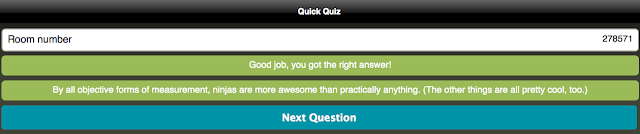
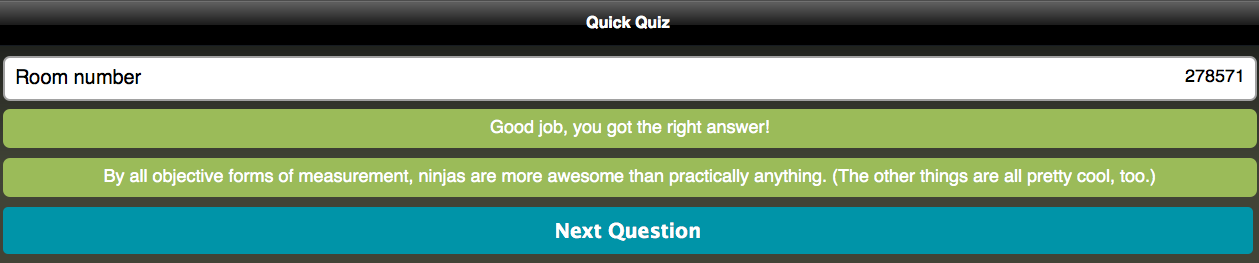
You can set the quiz to give instant feedback when an answer is selected. In this case, the answer was obviously "ninjas."
Now, while students are taking the quiz, the teacher can use their end of the software to monitor progress and results in real time:

Free-response questions can also be built into a Socrative quiz. Here's an example from the quiz from the staff meeting:

Now, obviously I use this in a far more practical manner in the classroom. (That's not to say that questions about ninjas and ice cream aren't important, BECAUSE THEY ARE.) For instance, here is the warm-up question I administered to my students this morning:

Now, here's the really cool part.
When I see that the students have finished, I end the activity. Then, I am presented with the option to e-mail a report to myself.

So this morning when my students finished their warm-up question, I had a report e-mailed to me. A few minutes later, this arrived in my inbox (student names have been removed):

Formative performance data that can inform and drive my classroom instruction to best meet the needs of my students? All organized and color-coded in an Excel spreadsheet? And this software is free? HOLY CRAP. YES PLEASE.
But wait! There's more!
If you don't have time to write a quiz in Socrative, that's no problem at all. Socrative also allows for a quick one-question option that allows you to assess students on the fly.
On the teacher control panel, you can choose to start a quick multiple choice, true/false, or short answer activity:

You can announce the question orally, or provide it in a written format on paper, dry erase board, online LMS, napkin, ankle tattoo, whatever. Say you wanted to do a true/false question. You select this option, and the students see this on their screen:

Notice that there's no question displayed. As I mentioned, it's up to you to present the question however you want. The point is that you can use Socrative on the fly to formatively assess your students as well. You can also monitor results in real time, though there won't be names attached (so this is also good for taking an anonymous poll). The downside, however, is that you can't e-mail a report to yourself in this mode.
So far, I'm seeing great advantages to using Socrative in my classroom. It's a very handy way for me to quickly collect and organize formative assessment data before, during, and after a lesson. It allows me to more effectively monitor my students' learning and to make appropriate instructional decisions. And, since Socrative can be downloaded as an app to mobile devices, it's also conducive to a BYOT classroom environment.
Probably the one thing I really wish Socrative could do is recognize math type. In the slope question above, I had to settle for typing "1/3" and "5/6" instead of putting them into a less-confusing vertical format. There's also no way to insert charts, graphs, tables, etc. There are ways to get around this, of course. (I can post the full question in another medium that supports math-type and have the students submit their responses via Socrative.) Still, it would be convenient to have these features present. (EDIT 8/22/2013: In the past year since this post was written, Socrative has added the ability to post images. This provides another way around the issue. Sweet!)
Overall, this is a great piece of software and is a very simple way of recording formative assessment data. Works great in a 1:1 technology environment, provides real-time results, and supports data-driven instructional practice. I give it four out of five ninjas.
RATING:
(Trust me, there are four ninjas next to "RATING:" here. You can't see them, because they're ninjas.)
I've been testing this out in my class for the past couple of weeks and have been rather impressed by the results.
There are essentially two modes for using Socrative: you can administer a pre-written quiz to your students with multiple-choice questions and free response questions, or you can administer a quick one-question activity on the fly.
I've been using the pre-built quiz feature for the past few days as a warm-up activity for my students when they get to my classroom. Students log on to their desktop computers (or sign on to Socrative on their smartphones) and complete a question related to the current skill they are working on.
I was asked to demonstrate Socrative to my colleagues at today's staff meeting, so I wrote a sample quiz for them. Here was one of the multiple-choice questions:

You can set the quiz to give instant feedback when an answer is selected. In this case, the answer was obviously "ninjas."
Now, while students are taking the quiz, the teacher can use their end of the software to monitor progress and results in real time:

Free-response questions can also be built into a Socrative quiz. Here's an example from the quiz from the staff meeting:

Now, obviously I use this in a far more practical manner in the classroom. (That's not to say that questions about ninjas and ice cream aren't important, BECAUSE THEY ARE.) For instance, here is the warm-up question I administered to my students this morning:

Now, here's the really cool part.
When I see that the students have finished, I end the activity. Then, I am presented with the option to e-mail a report to myself.

So this morning when my students finished their warm-up question, I had a report e-mailed to me. A few minutes later, this arrived in my inbox (student names have been removed):

Formative performance data that can inform and drive my classroom instruction to best meet the needs of my students? All organized and color-coded in an Excel spreadsheet? And this software is free? HOLY CRAP. YES PLEASE.
But wait! There's more!
If you don't have time to write a quiz in Socrative, that's no problem at all. Socrative also allows for a quick one-question option that allows you to assess students on the fly.
On the teacher control panel, you can choose to start a quick multiple choice, true/false, or short answer activity:
You can announce the question orally, or provide it in a written format on paper, dry erase board, online LMS, napkin, ankle tattoo, whatever. Say you wanted to do a true/false question. You select this option, and the students see this on their screen:

Notice that there's no question displayed. As I mentioned, it's up to you to present the question however you want. The point is that you can use Socrative on the fly to formatively assess your students as well. You can also monitor results in real time, though there won't be names attached (so this is also good for taking an anonymous poll). The downside, however, is that you can't e-mail a report to yourself in this mode.
So far, I'm seeing great advantages to using Socrative in my classroom. It's a very handy way for me to quickly collect and organize formative assessment data before, during, and after a lesson. It allows me to more effectively monitor my students' learning and to make appropriate instructional decisions. And, since Socrative can be downloaded as an app to mobile devices, it's also conducive to a BYOT classroom environment.
Probably the one thing I really wish Socrative could do is recognize math type. In the slope question above, I had to settle for typing "1/3" and "5/6" instead of putting them into a less-confusing vertical format. There's also no way to insert charts, graphs, tables, etc. There are ways to get around this, of course. (I can post the full question in another medium that supports math-type and have the students submit their responses via Socrative.) Still, it would be convenient to have these features present. (EDIT 8/22/2013: In the past year since this post was written, Socrative has added the ability to post images. This provides another way around the issue. Sweet!)
Overall, this is a great piece of software and is a very simple way of recording formative assessment data. Works great in a 1:1 technology environment, provides real-time results, and supports data-driven instructional practice. I give it four out of five ninjas.
RATING:
(Trust me, there are four ninjas next to "RATING:" here. You can't see them, because they're ninjas.)
Monday, September 3, 2012
It's School Again! Huzzah! (Part 2 of 2)
The freshmen had their first day of school with us last Tuesday; on Wednesday, the rest of our students returned and I got to see my seniors for the first time since I last had them all as sophomores.
This year, one of my goals for my math class is to get my students writing more and to practice digital citizenship by focusing on communicating with peers in an online environment. To that end, one of our opening activities was for students to respond to a discussion board prompt on our echo course page.
The questions were pretty simple:

Many of the responses were encouraging to read; a lot of students stated they were planning to go to college after high school and that they were excited for graduation. Several students said they were excited to have me as their teacher again because they enjoyed how I teach (which I'm not particularly sure how to feel about since I think I was probably doing many things wrong two years ago).
Some students had their priorities straight:

While other students took a rather avant-garde approach:

Still, I learned a great deal about my students. A few of them said they wanted to go into graphic design; one wants to be a zoologist; one is thinking about cinematography or film; a few are considering getting business degrees; one wants to be a mechanic; one has aspirations of joining the FBI; some are planning to go into the military; and many, many more. There is a lengthy, eclectic list of careers my students want to pursue after high school, which is awesome.
Other students are unsure of what they want to do after they finish high school, which is also okay. I'm hoping that during this year I can connect with these students and help them figure out plans and goals for themselves for a post-high school existence.
At any rate, this discussion board activity served two important purposes. First, as I just detailed above, I learned a lot about my students. I know more about their post-graduation plans and their interests, which will help me a great deal in tailoring our class to incorporate their interests. Second, the activity established a baseline for their ability to communicate and interact with each other in a supervised online environment.
I saw some good things. The students were able to follow directions well for the most part, did an "okay" job of using polite language (save for one student who jokingly said her mom would "beat her ass" if she didn't get a good grade in math), and responded to each other's posts while making an effort to comport professionally.
I also saw some things that need a lot of work. The vast majority of the students re-posted each question and answered them in a list format. I would like to see them get away from re-posting questions and answering in a paragraph form. (Not that answering in a list format is necessarily a bad thing, but I would like to see them practice putting their thoughts together in a coherent, flowing format.) Spelling, grammar, and punctuation remains an issue; I realize that I'm a math teacher, but that doesn't mean I can't give them feedback on these things. (Actually, I minored in English at Michigan State, and am certified to teach the subject in the state of Michigan.) The replies that students wrote to each original post were also, for the most part, superficial. I saw a lot of "I agree with you"-type posts that had little depth and weren't suited to continuing the conversation. Again, not necessarily a bad thing; plus, I wasn't expecting most of the students to be able to do this on the first go. We were simply establishing a baseline to help us identify what to work on. By the end of the year, I'm hoping to see well-crafted, thoughtful responses and replies that result in deeper conversation. (To be fair, this probably requires a deeper topic than what I gave them to start with.)
Outside of the discussion post activity, the majority of the time was spent administering a math benchmark test to establish where the students are in terms of content mastery. This benchmark will help me determine what the students already know, what they still need to master, and thus where we should focus our efforts as far as mastering content is concerned.
Probably the coolest thing of the week that happened was Friday. Many students still needed to finish their benchmark from Wednesday/Thursday, while others were already finished and weren't going to have much else to do. This seemed like a great opportunity to preview the election-themed project that we're going to be launching when we come back from Labor Day weekend.
I decided to get together the students who were already finished with their benchmark in each class for a Critical Friends session. The students had seen the Critical Friends protocol in their sophomore English class and were somewhat familiar with the procedures, so I gave each class a quick refresher before starting.
It went alright in my 1st period class, but the students more frequently got off-task in 2nd period. I realized that I needed to designate a few students to be responsible for steering the "I Like/I Wonder/Next Steps" portion of the session and keeping everyone focused on the task at hand. So, in my 3rd period, I asked the group if anyone was comfortable leading the discussion. Three students immediately spoke up, so I told them they were responsible for keeping everyone on task. I presented the project idea and sat back to let the students discuss it.
I hadn't expected what transpired next.
One of the students I designated to lead the discussion immediately chose a student to read the entry document out loud. The other students all listened intently as she read through the entry doc. After she was done, one of the other student leaders grabbed a dry erase marker to start writing "I Likes," "I Wonders," and "Next Steps" on the board while the other two called on students for their feedback.
I was amazed. I was very proud and excited. I thought to myself, "SOMEONE HAS TO SEE THIS!!"
So I shot a quick Skype message to our assistant principal, who came down a few minutes later as the session got in full swing. We were enraptured by how well the students had taken over the conversation, listing several "I Likes," "I Wonders," and "Next Steps" while conducting themselves in an orderly fashion:


I was very impressed with what the students were able to do on their own. I had actually intended to listen to their conversation and write down all of their feedback myself (as I had done for the first two periods), but they completely took care of that for me! The only thing I'd done was to assign a few students to lead the discussion, and they took it from there! It was really awesome to watch.
I did the same thing with my 4th period class and got similar results. Our principal stopped by my room during that period and was very proud of the students for what they were doing -- she even joined in and gave some Critical Friends feedback herself!
As I said, the students had previous experience with the Critical Friends process in their sophomore English class, so I made sure to track her down and let her know what had transpired in my class. When I told her they not only remembered Critical Friends, but successfully ran a session on their own, she did a happy dance. I imagine the news must have been incredibly satisfying -- it showed that these students had actually been listening to her two years ago.
So my week ended on a high note. The students gave me some great feedback for our project, and most of them seemed to be interested in the idea.
I would love to expound more on Week 1 (and I did give an update on the Ninja Board), but there's still much I need to do for Week 2! A teacher's work is never done. Until next time!
This year, one of my goals for my math class is to get my students writing more and to practice digital citizenship by focusing on communicating with peers in an online environment. To that end, one of our opening activities was for students to respond to a discussion board prompt on our echo course page.
The questions were pretty simple:

Many of the responses were encouraging to read; a lot of students stated they were planning to go to college after high school and that they were excited for graduation. Several students said they were excited to have me as their teacher again because they enjoyed how I teach (which I'm not particularly sure how to feel about since I think I was probably doing many things wrong two years ago).
Some students had their priorities straight:

While other students took a rather avant-garde approach:

Still, I learned a great deal about my students. A few of them said they wanted to go into graphic design; one wants to be a zoologist; one is thinking about cinematography or film; a few are considering getting business degrees; one wants to be a mechanic; one has aspirations of joining the FBI; some are planning to go into the military; and many, many more. There is a lengthy, eclectic list of careers my students want to pursue after high school, which is awesome.
Other students are unsure of what they want to do after they finish high school, which is also okay. I'm hoping that during this year I can connect with these students and help them figure out plans and goals for themselves for a post-high school existence.
At any rate, this discussion board activity served two important purposes. First, as I just detailed above, I learned a lot about my students. I know more about their post-graduation plans and their interests, which will help me a great deal in tailoring our class to incorporate their interests. Second, the activity established a baseline for their ability to communicate and interact with each other in a supervised online environment.
I saw some good things. The students were able to follow directions well for the most part, did an "okay" job of using polite language (save for one student who jokingly said her mom would "beat her ass" if she didn't get a good grade in math), and responded to each other's posts while making an effort to comport professionally.
I also saw some things that need a lot of work. The vast majority of the students re-posted each question and answered them in a list format. I would like to see them get away from re-posting questions and answering in a paragraph form. (Not that answering in a list format is necessarily a bad thing, but I would like to see them practice putting their thoughts together in a coherent, flowing format.) Spelling, grammar, and punctuation remains an issue; I realize that I'm a math teacher, but that doesn't mean I can't give them feedback on these things. (Actually, I minored in English at Michigan State, and am certified to teach the subject in the state of Michigan.) The replies that students wrote to each original post were also, for the most part, superficial. I saw a lot of "I agree with you"-type posts that had little depth and weren't suited to continuing the conversation. Again, not necessarily a bad thing; plus, I wasn't expecting most of the students to be able to do this on the first go. We were simply establishing a baseline to help us identify what to work on. By the end of the year, I'm hoping to see well-crafted, thoughtful responses and replies that result in deeper conversation. (To be fair, this probably requires a deeper topic than what I gave them to start with.)
Outside of the discussion post activity, the majority of the time was spent administering a math benchmark test to establish where the students are in terms of content mastery. This benchmark will help me determine what the students already know, what they still need to master, and thus where we should focus our efforts as far as mastering content is concerned.
Probably the coolest thing of the week that happened was Friday. Many students still needed to finish their benchmark from Wednesday/Thursday, while others were already finished and weren't going to have much else to do. This seemed like a great opportunity to preview the election-themed project that we're going to be launching when we come back from Labor Day weekend.
I decided to get together the students who were already finished with their benchmark in each class for a Critical Friends session. The students had seen the Critical Friends protocol in their sophomore English class and were somewhat familiar with the procedures, so I gave each class a quick refresher before starting.
It went alright in my 1st period class, but the students more frequently got off-task in 2nd period. I realized that I needed to designate a few students to be responsible for steering the "I Like/I Wonder/Next Steps" portion of the session and keeping everyone focused on the task at hand. So, in my 3rd period, I asked the group if anyone was comfortable leading the discussion. Three students immediately spoke up, so I told them they were responsible for keeping everyone on task. I presented the project idea and sat back to let the students discuss it.
I hadn't expected what transpired next.
One of the students I designated to lead the discussion immediately chose a student to read the entry document out loud. The other students all listened intently as she read through the entry doc. After she was done, one of the other student leaders grabbed a dry erase marker to start writing "I Likes," "I Wonders," and "Next Steps" on the board while the other two called on students for their feedback.
I was amazed. I was very proud and excited. I thought to myself, "SOMEONE HAS TO SEE THIS!!"
So I shot a quick Skype message to our assistant principal, who came down a few minutes later as the session got in full swing. We were enraptured by how well the students had taken over the conversation, listing several "I Likes," "I Wonders," and "Next Steps" while conducting themselves in an orderly fashion:


I was very impressed with what the students were able to do on their own. I had actually intended to listen to their conversation and write down all of their feedback myself (as I had done for the first two periods), but they completely took care of that for me! The only thing I'd done was to assign a few students to lead the discussion, and they took it from there! It was really awesome to watch.
I did the same thing with my 4th period class and got similar results. Our principal stopped by my room during that period and was very proud of the students for what they were doing -- she even joined in and gave some Critical Friends feedback herself!
As I said, the students had previous experience with the Critical Friends process in their sophomore English class, so I made sure to track her down and let her know what had transpired in my class. When I told her they not only remembered Critical Friends, but successfully ran a session on their own, she did a happy dance. I imagine the news must have been incredibly satisfying -- it showed that these students had actually been listening to her two years ago.
So my week ended on a high note. The students gave me some great feedback for our project, and most of them seemed to be interested in the idea.
I would love to expound more on Week 1 (and I did give an update on the Ninja Board), but there's still much I need to do for Week 2! A teacher's work is never done. Until next time!
Sunday, September 2, 2012
Ninja Board Update: Week 1
Previously, I talked about this silly idea I had to implement an achievement system themed around ninjas for some reason. The original intention was to see whether or not it would have an affect on student motivation in my class, particularly in the academic respect.
While there have only been three days of school so far and it's waaaaay too early to tell whether or not this will be the case (just as ESPN.com is jumping the gun on projecting my Spartans to go to the Rose Bowl), I made an important realization: the Ninja Board is perhaps going to be far more useful as a tool for developing classroom culture (which, of course, would affect student motivation in turn). This is because I can use it to define and recognize those "awesome moments" in class and capture them for posterity.
Some things went according to plan on the first day. I said absolutely nothing about the Ninja Board. I didn't even point it out. I was secretly planning to award the first ninja point to the first student who asked about the Ninja Board. I figured someone was going to at some point.
The entire first block passed without anyone asking about it.
I was genuinely surprised at first; then I began to think that perhaps nobody would ask about it unless there was more to pique their curiosity than just a blank wall.
I looked for other opportunities to award ninja points to a few students. During my second block class -- which also ended up passing by without anyone noticing the Ninja Board -- one of my students asked me if I wanted to see the folder she was using for my class. I said I would love to, so she reached into her binder and pulled this out:

COOLEST FOLDER EVER.
So I decided to award her a ninja point for being the "first to bring in a ninja item."
I have a particular way of awarding ninja points. When a student does something worthy of a ninja point, I say nothing. I don't announce, "CONGRATULATIONS! YOU WIN A NINJA POINT!" (Doing so would be very un-ninja-like; ninjas don't announce to their victims, "GREETINGS! I AM ABOUT TO ASSASSINATE YOU WITH THIS KATANA! YOU'D BEST ATTEMPT TO FLEE!")
Instead, I jot a note to myself on my iPad: I write down the student's name, how many points they earned, and the reason they earned the points. During my planning time, I make a sign for each student that earned ninja points:

Before I leave school for the day, I tape all the signs to the wall. The students don't find out that they earned ninja points until the next day when they come back and see their names posted.
So after the first day, I picked out three students who earned a ninja point. (And the cool thing is that since I tell the students absolutely nothing about the Ninja Board, I can come up with all kinds of reasons to award ninja points.)
The next day, another block period passed without any questions about the Ninja Board. Finally, however, one student approached me during second block with the question:
"Hey Mr. B, what's the Ninja Board?"
I smiled. I smiled partly because I was happy someone had finally asked me that question after nearly two days of waiting. I smiled partly because she was going to get a ninja point for asking that question. Mostly, though, I smiled because I knew what my answer was going to be:
"That is an excellent question."
And I said nothing else. I think I giggled involuntarily.
A few more students earned ninja points on the second day, and more names were added. On Friday, I have several more inquiries about the Ninja Board, and each time I replied with a non-answer. Slowly but surely, interest in the Ninja Board started picking up.
Even though I'm being incredibly stubborn with my refusal to explain the Ninja Board to my students, I do want them to know what they're earning ninja points for. So, in addition to their names, I also post a list of "unlocked ninja achievements." Here's the complete list from the first week of school:

In all honesty, only about one or two of these "achievements" were pre-planned. The rest are being made up as I go. When I notice my students doing something really awesome, like demonstrating leadership or kindness, that kind of thing deserves ninja points. If I have one of those little student/teacher "moments" where we're building or supporting good rapport, I give ninja points for those, too. To keep my students on their toes (and partly to include those students who are traditionally the "invisible" ones), I also award ninja points for other random things.
It seems to add a certain whimsy to our classroom culture that I particularly enjoy. I'm curious to see how the Ninja Board will continue to play out in week two.
Incidentally, there's much more about the Ninja Board that I haven't revealed yet on this blog -- but that can wait for another time.
While there have only been three days of school so far and it's waaaaay too early to tell whether or not this will be the case (just as ESPN.com is jumping the gun on projecting my Spartans to go to the Rose Bowl), I made an important realization: the Ninja Board is perhaps going to be far more useful as a tool for developing classroom culture (which, of course, would affect student motivation in turn). This is because I can use it to define and recognize those "awesome moments" in class and capture them for posterity.
Some things went according to plan on the first day. I said absolutely nothing about the Ninja Board. I didn't even point it out. I was secretly planning to award the first ninja point to the first student who asked about the Ninja Board. I figured someone was going to at some point.
The entire first block passed without anyone asking about it.
I was genuinely surprised at first; then I began to think that perhaps nobody would ask about it unless there was more to pique their curiosity than just a blank wall.
I looked for other opportunities to award ninja points to a few students. During my second block class -- which also ended up passing by without anyone noticing the Ninja Board -- one of my students asked me if I wanted to see the folder she was using for my class. I said I would love to, so she reached into her binder and pulled this out:

COOLEST FOLDER EVER.
So I decided to award her a ninja point for being the "first to bring in a ninja item."
I have a particular way of awarding ninja points. When a student does something worthy of a ninja point, I say nothing. I don't announce, "CONGRATULATIONS! YOU WIN A NINJA POINT!" (Doing so would be very un-ninja-like; ninjas don't announce to their victims, "GREETINGS! I AM ABOUT TO ASSASSINATE YOU WITH THIS KATANA! YOU'D BEST ATTEMPT TO FLEE!")
Instead, I jot a note to myself on my iPad: I write down the student's name, how many points they earned, and the reason they earned the points. During my planning time, I make a sign for each student that earned ninja points:

So after the first day, I picked out three students who earned a ninja point. (And the cool thing is that since I tell the students absolutely nothing about the Ninja Board, I can come up with all kinds of reasons to award ninja points.)
The next day, another block period passed without any questions about the Ninja Board. Finally, however, one student approached me during second block with the question:
"Hey Mr. B, what's the Ninja Board?"
I smiled. I smiled partly because I was happy someone had finally asked me that question after nearly two days of waiting. I smiled partly because she was going to get a ninja point for asking that question. Mostly, though, I smiled because I knew what my answer was going to be:
"That is an excellent question."
And I said nothing else. I think I giggled involuntarily.
A few more students earned ninja points on the second day, and more names were added. On Friday, I have several more inquiries about the Ninja Board, and each time I replied with a non-answer. Slowly but surely, interest in the Ninja Board started picking up.
Even though I'm being incredibly stubborn with my refusal to explain the Ninja Board to my students, I do want them to know what they're earning ninja points for. So, in addition to their names, I also post a list of "unlocked ninja achievements." Here's the complete list from the first week of school:
In all honesty, only about one or two of these "achievements" were pre-planned. The rest are being made up as I go. When I notice my students doing something really awesome, like demonstrating leadership or kindness, that kind of thing deserves ninja points. If I have one of those little student/teacher "moments" where we're building or supporting good rapport, I give ninja points for those, too. To keep my students on their toes (and partly to include those students who are traditionally the "invisible" ones), I also award ninja points for other random things.
It seems to add a certain whimsy to our classroom culture that I particularly enjoy. I'm curious to see how the Ninja Board will continue to play out in week two.
Incidentally, there's much more about the Ninja Board that I haven't revealed yet on this blog -- but that can wait for another time.
It's School Again! Huzzah! (Part 1 of 2)
Happy Labor Day weekend, everyone!
First, a big thank-you to everyone who has checked out this blog over the past couple of days! Please feel free to stick around just in case I write something worth reading someday!
So, my wife and I spent most of yesterday driving from Chicago to her grandparents' condo in Ohio, where the rest of her family has gathered for the long weekend. On the way, we dropped off our dog, Jake, at a fancy-schmancy doggy bed & breakfast for his first-ever weekend without Mommy and Daddy.
It was a bit hard for us. I mean, LOOK AT HIM.

Anyway, canine parental guilt aside: After driving several hours, heading out for an awesome dinner with the family, playing some games, etc., I found some time to sit down and reflect on the first week of the school year.
SPOILER ALERT: It was awesome.
Tuesday was a freshmen-only half day, designed to get our new students acquainted with our school. The teachers lined up outside the building to welcome each and every freshman as they walked into the building.

It was a total blast to stand outside, welcoming our new students as they trudged past us, one by one, with the sleep not yet completely rubbed out of their eyes. We greeted them with enthusiasm, high fives, and fist bumps. A few responded with the same energy. Many more obliged us begrudgingly. Some looked at us as if we had just picked our noses with an acetylene torch. One or two "anti-establishment" types elected not to partake in such frivolity, to which I replied, "I respect your non-conformity, don't ever lose that." They looked confused.
By 7:30, the freshmen had found their way into our cafeteria for welcomes and introductions. They were seated by their Advisory groups and assigned a senior leader, who would be showing them around the school, helping them find their lockers, etc. Our school's director (which is New Tech lingo for the role of "principal") greeted the students warmly, then had each teacher introduce himself or herself.

As I stood in line waiting for my turn, I whipped out my iPad and loaded the Notability app, quickly scribbling something with my finger. When the time came to introduce myself, I took a few steps out and, silent, stone-faced, held up my iPad for the freshmen to see:

After a few long moments (I was purposefully aiming for John Cage-like silence), I spun around and went back into the line without saying a word.
This prompted laughter from most of the freshmen, confused looks from the rest.
(Then I actually introduced myself "normally," discussing who I am, what subject and grade I teach, and that I also run Anime Club during lunch three days a week.)
Throughout the morning, I had the opportunity to meet each freshman group in my classroom. While I'm sure that most of them were already convinced that I was a total weirdo, I threw up a Keynote slide I had whipped together to remove any lingering doubts:

I later tweeted a reaction I got when expounding upon my favorite video games to play:

Only an hour or two into the school year, I had most of the freshmen scratching their heads and wondering what was up with this strange man who was going to be teaching them math in their senior year.
Probably the coolest thing about the interactions I had with the freshmen on day one was that many of them seemed to relax ever-so-slightly from the typical first-day jitters and culture shock.
Several freshmen approached me that morning about joining Anime Club. On the very first day. I'd never had that happen before. A few other freshmen came up to me to declare that I was already their favorite teacher, even though they wouldn't be having me until senior year.
It was a cool feeling to hear them say that, but it was not really the point. The point was to make them feel welcome, and to let them know that I was totally willing to be just as goofy with them as I am with the seniors who are actually taking my math class. The point was to make the feel like they were already part of the family.
Because they are. They are every bit as much a part of our school's family as our first graduating class that started college this fall. They are every bit as much a part of our school's family as our current group of seniors, who I got to see the next day for the start of their school year...
First, a big thank-you to everyone who has checked out this blog over the past couple of days! Please feel free to stick around just in case I write something worth reading someday!
So, my wife and I spent most of yesterday driving from Chicago to her grandparents' condo in Ohio, where the rest of her family has gathered for the long weekend. On the way, we dropped off our dog, Jake, at a fancy-schmancy doggy bed & breakfast for his first-ever weekend without Mommy and Daddy.
It was a bit hard for us. I mean, LOOK AT HIM.

Anyway, canine parental guilt aside: After driving several hours, heading out for an awesome dinner with the family, playing some games, etc., I found some time to sit down and reflect on the first week of the school year.
SPOILER ALERT: It was awesome.
Tuesday was a freshmen-only half day, designed to get our new students acquainted with our school. The teachers lined up outside the building to welcome each and every freshman as they walked into the building.

It was a total blast to stand outside, welcoming our new students as they trudged past us, one by one, with the sleep not yet completely rubbed out of their eyes. We greeted them with enthusiasm, high fives, and fist bumps. A few responded with the same energy. Many more obliged us begrudgingly. Some looked at us as if we had just picked our noses with an acetylene torch. One or two "anti-establishment" types elected not to partake in such frivolity, to which I replied, "I respect your non-conformity, don't ever lose that." They looked confused.
By 7:30, the freshmen had found their way into our cafeteria for welcomes and introductions. They were seated by their Advisory groups and assigned a senior leader, who would be showing them around the school, helping them find their lockers, etc. Our school's director (which is New Tech lingo for the role of "principal") greeted the students warmly, then had each teacher introduce himself or herself.

As I stood in line waiting for my turn, I whipped out my iPad and loaded the Notability app, quickly scribbling something with my finger. When the time came to introduce myself, I took a few steps out and, silent, stone-faced, held up my iPad for the freshmen to see:

After a few long moments (I was purposefully aiming for John Cage-like silence), I spun around and went back into the line without saying a word.
This prompted laughter from most of the freshmen, confused looks from the rest.
(Then I actually introduced myself "normally," discussing who I am, what subject and grade I teach, and that I also run Anime Club during lunch three days a week.)
Throughout the morning, I had the opportunity to meet each freshman group in my classroom. While I'm sure that most of them were already convinced that I was a total weirdo, I threw up a Keynote slide I had whipped together to remove any lingering doubts:

I later tweeted a reaction I got when expounding upon my favorite video games to play:
Only an hour or two into the school year, I had most of the freshmen scratching their heads and wondering what was up with this strange man who was going to be teaching them math in their senior year.
Probably the coolest thing about the interactions I had with the freshmen on day one was that many of them seemed to relax ever-so-slightly from the typical first-day jitters and culture shock.
Several freshmen approached me that morning about joining Anime Club. On the very first day. I'd never had that happen before. A few other freshmen came up to me to declare that I was already their favorite teacher, even though they wouldn't be having me until senior year.
It was a cool feeling to hear them say that, but it was not really the point. The point was to make them feel welcome, and to let them know that I was totally willing to be just as goofy with them as I am with the seniors who are actually taking my math class. The point was to make the feel like they were already part of the family.
Because they are. They are every bit as much a part of our school's family as our first graduating class that started college this fall. They are every bit as much a part of our school's family as our current group of seniors, who I got to see the next day for the start of their school year...
Tuesday, August 28, 2012
Ninjas: Undeniably Awesome. But Student Motivational Tool?
Tomorrow morning will be my first day with my students. When they walk into the room, this is one of the things they'll see:

Yep. A section of blank wall that I have dubbed "The Ninja Board."
What is it?
That's what my students are inevitably going to ask me. And I'm not going to tell them.
But I'll tell you: It's a type of "achievement" system, similar to what one might find in video games. In fact, I'm pretty much ripping this off of the clan rank system from Final Fantasy XII, which I played in my spare time this summer.
The idea is simple: Students do things in class that earn them "ninja points." This can be anything: Completing assignments, demonstrating knowledge at a certain threshold of rigor, developing an interesting project, etc. Lots of things can earn "ninja points." Enough ninja points, along with completing other certain tasks, will allow students to gain a ninja rank ("Level 1 Ninja," "Apprentice Ninja," "Super-Awesome Math Ninja," etc.). Their ranks, in turn, will be displayed alongside their names on the ninja board.
I'm purposely not going to tell my students what they can do to earn ninja points or ranks. I want them to discover that on their own. They'll have no idea what's up until the first student earns ninja points and gets their name put on the board, with a point tally and a rank.
Then everyone will start to get it. And chances are they'll want a piece of the glory, too.
I want them to be curious about what they can do in class to earn ninja points, and then try to figure out on their own what those things are. When a student does do something that earns ninja points, or when a student does gain a rank, the knowledge of how they did so will be published to the ninja board. So they'll slowly learn how to get ninja points and ninja ranks as they go along.
Is it cheesy? Yes.
Is it completely silly? Of course.
But what if my students buy into it?
It's possible some really cool stuff could happen as a result.
I'm hoping to see increased student motivation in different areas of our class. I'm trying many new things this year -- discussion board posts, journal prompts, student blogging, and so forth -- and I would love to see my students get really creative and really deep with these things. The Ninja Board might help facilitate this. Like I said, there are many things that could earn ninja points. Perhaps a particularly thoughtful discussion post; a journal entry where the student talks about a real learning breakthrough they had; or a voluntarily-written blog post on a really cool topic.
Here's what I think might be the real beauty of it: I honestly haven't given much thought to what specifically can earn ninja points. But I'm willing to bet that my students will try out a bunch of different things, or ask me about different ways to earn ninja points. And some of what they try might actually be pretty cool, thus legitimately worthy of ninja points.
In other words, the students themselves will determine what earns ninja points, not me.
So it starts tomorrow, and we're going to see how it goes. It could fall flat on its face. It could be fun for a while and then get old. Or, it could be really super-cool and lead to some unexpected (and pleasant) results.
"Why ninjas?" you might ask.
I'll tell you why: because they're totally sweet.

Related: Ninja Board Update: Week 1

Yep. A section of blank wall that I have dubbed "The Ninja Board."
What is it?
That's what my students are inevitably going to ask me. And I'm not going to tell them.
But I'll tell you: It's a type of "achievement" system, similar to what one might find in video games. In fact, I'm pretty much ripping this off of the clan rank system from Final Fantasy XII, which I played in my spare time this summer.
The idea is simple: Students do things in class that earn them "ninja points." This can be anything: Completing assignments, demonstrating knowledge at a certain threshold of rigor, developing an interesting project, etc. Lots of things can earn "ninja points." Enough ninja points, along with completing other certain tasks, will allow students to gain a ninja rank ("Level 1 Ninja," "Apprentice Ninja," "Super-Awesome Math Ninja," etc.). Their ranks, in turn, will be displayed alongside their names on the ninja board.
I'm purposely not going to tell my students what they can do to earn ninja points or ranks. I want them to discover that on their own. They'll have no idea what's up until the first student earns ninja points and gets their name put on the board, with a point tally and a rank.
Then everyone will start to get it. And chances are they'll want a piece of the glory, too.
I want them to be curious about what they can do in class to earn ninja points, and then try to figure out on their own what those things are. When a student does do something that earns ninja points, or when a student does gain a rank, the knowledge of how they did so will be published to the ninja board. So they'll slowly learn how to get ninja points and ninja ranks as they go along.
Is it cheesy? Yes.
Is it completely silly? Of course.
But what if my students buy into it?
It's possible some really cool stuff could happen as a result.
I'm hoping to see increased student motivation in different areas of our class. I'm trying many new things this year -- discussion board posts, journal prompts, student blogging, and so forth -- and I would love to see my students get really creative and really deep with these things. The Ninja Board might help facilitate this. Like I said, there are many things that could earn ninja points. Perhaps a particularly thoughtful discussion post; a journal entry where the student talks about a real learning breakthrough they had; or a voluntarily-written blog post on a really cool topic.
Here's what I think might be the real beauty of it: I honestly haven't given much thought to what specifically can earn ninja points. But I'm willing to bet that my students will try out a bunch of different things, or ask me about different ways to earn ninja points. And some of what they try might actually be pretty cool, thus legitimately worthy of ninja points.
In other words, the students themselves will determine what earns ninja points, not me.
So it starts tomorrow, and we're going to see how it goes. It could fall flat on its face. It could be fun for a while and then get old. Or, it could be really super-cool and lead to some unexpected (and pleasant) results.
"Why ninjas?" you might ask.
I'll tell you why: because they're totally sweet.

Related: Ninja Board Update: Week 1
Subscribe to:
Posts (Atom)