Happy New Year, everyone!
It's been a while since I last released one of my incoherent ramblings into the wild jungles of cyberspace, and I
have much to talk about, so expect to see a few more posts in the coming
days. (And if you don't see said posts materialize, please nag me until
I get them done.)
(As a side note, as of this writing, my blog has about 25,000 views accumulated since my first post in July. 20,000 of those views are attributed to a post I wrote in August about the ninja board. Apparently Google likes ninjas.)
My school resumed classes today, and
1st semester final exams are coming up in a week and a half. That means
the time has come to start reviewing for finals.
I've
been wondering about this lately, the idea of spending a week and a
half of class time reviewing for final exams. I'm not completely sure I
ever do it the right way. Actually, I often wonder if there even is a right way.
Does it even do any good to review for final exams?
Every
semester, I take the last week and a half or so before final exams to
review with my students everything that we learned over the prior 16-17
weeks, tell them what kinds of questions to expect on the final exam and
how many, give them time to work on review packets/assignments/flaming
obstacle courses, etc. and so forth.
I've tried various
ways of helping my students to take stock of what they learned (or were
supposed to learn) over the semester. We've done the "review for finals
process" as a project (with a rubric and everything) where students had
to develop and publish their own study guides. We've done the classic
"Jeopardy!"-style review game. We've done notecards that students were
allowed to use on the final. We've done review assignments with the
final exam questions literally lifted from the exam itself, with the numbers changed.
And
what bothers me is this: Not once, that I can recall, in the four years
I've spent teaching so far, have I been able to discern whether or not
these methods of reviewing have done any good to any of my students.
What appears to happen is that the students who more or less have been "getting it"
(or have been perpetually on the cusp of "getting it") all along are
best equipped to understand and solve the problems set before them on
the review assignments. Students who have been struggling all semester
-- for whatever reason -- also struggle to find success on review
assignments. It strikes me as a situation where the students who benefit
the most from reviewing for finals are also the ones who need it the
least, and the ones who benefit the least are the ones who need it the
most.
I don't know why this appears to happen. (Or, if I'm really being honest, if it actually is what happens.)
Maybe I haven't been making enough of an effort to find out. Maybe it's some bizarre phenomenon that can't be explained, like Honey Boo Boo. Maybe I suck at teaching. (Okay, maybe not.)
I was
discussing this matter with my lovely wife the other night, and she
asked me, "well, how do you know whether or not it's helping your
students?" I thought about it, couldn't come up with a great answer, got
childishly frustrated then stammered something like, "it's just based
on what I've observed in class, I don't know how to explain it!" Then I
pouted and decided to go do something else, because I'm so mature.
The bottom line is, I've
never really been confident in my approach to reviewing for finals. I haven't made it easy for myself to tell whether or not my approach has a positive (or negative) effect. Maybe that's what makes me wonder if reviewing does any actual good.
Perhaps in the
naivety of being a young teacher, I've been thinking of it the wrong
way. I think the best way to describe how I've approached reviewing for
finals is that I've seen it as an eleventh-hour scaffolding activity,
intended to give students one last hope at having a mathematical epiphany, a lifeboat that will float them safely through the perilous, shark-infested tides of the final exam.
It never seems to really work that way. No lifeboats. Sharks with happy tummies.
Maybe I should be looking at reviewing for the final exam as part of the cumulative assessment itself. Reviewing should really be more of a time for reflection and fine-tuning, not making a last-ditch effort for comprehending something for the first time. That's not to say there won't be a few students that do get that benefit from reviewing, but that shouldn't be the point. The point should be to look back at all of the work we've done all semester, take stock of what we've learned and what we still have questions about, address areas that still need addressed, and perhaps even celebrate.
My angst aside, here's what I'm trying this time around. The other day, I remembered something I read on David Coffey's blog about giving students the answers to the problems and having them explain how to get that answer. In my case, I'm going to provide students with a set of problems that are similar to what's on the final exam, give them all of the answers, and require them to explain how to get each answer. This way, they focus on how to solve the problem as opposed to focusing on getting the right answer.
I don't really know if this will be any better or any worse than what I've tried in the past. But, I think it will at least alleviate some of the anxiety and second-guessing that comes with reviewing for final exams. We have a week and a half, which should be plenty of time to address any questions or concerns that arise as students work through their review assignments, particularly since I am putting the focus on articulating their mathematical thought processes.
Will it do any good? Your guess is as good as mine.

Education, math, project-based learning, other stuff, and possibly ninjas.
Showing posts with label assessment. Show all posts
Showing posts with label assessment. Show all posts
Monday, January 7, 2013

Wednesday, September 12, 2012
A Not-At-All Comprehensive Review of Socrative
At the start of the school year, our Assistant Principal introduced me to a student clicker-type program called Socrative. It's free and can be used in your web browser or downloaded as an app to a mobile device (available for iOS and Android devices).
I've been testing this out in my class for the past couple of weeks and have been rather impressed by the results.
There are essentially two modes for using Socrative: you can administer a pre-written quiz to your students with multiple-choice questions and free response questions, or you can administer a quick one-question activity on the fly.
I've been using the pre-built quiz feature for the past few days as a warm-up activity for my students when they get to my classroom. Students log on to their desktop computers (or sign on to Socrative on their smartphones) and complete a question related to the current skill they are working on.
I was asked to demonstrate Socrative to my colleagues at today's staff meeting, so I wrote a sample quiz for them. Here was one of the multiple-choice questions:

You can set the quiz to give instant feedback when an answer is selected. In this case, the answer was obviously "ninjas."
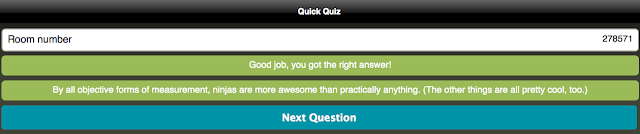
Now, while students are taking the quiz, the teacher can use their end of the software to monitor progress and results in real time:

Free-response questions can also be built into a Socrative quiz. Here's an example from the quiz from the staff meeting:

Now, obviously I use this in a far more practical manner in the classroom. (That's not to say that questions about ninjas and ice cream aren't important, BECAUSE THEY ARE.) For instance, here is the warm-up question I administered to my students this morning:

Now, here's the really cool part.
When I see that the students have finished, I end the activity. Then, I am presented with the option to e-mail a report to myself.

So this morning when my students finished their warm-up question, I had a report e-mailed to me. A few minutes later, this arrived in my inbox (student names have been removed):

Formative performance data that can inform and drive my classroom instruction to best meet the needs of my students? All organized and color-coded in an Excel spreadsheet? And this software is free? HOLY CRAP. YES PLEASE.
But wait! There's more!
If you don't have time to write a quiz in Socrative, that's no problem at all. Socrative also allows for a quick one-question option that allows you to assess students on the fly.
On the teacher control panel, you can choose to start a quick multiple choice, true/false, or short answer activity:

You can announce the question orally, or provide it in a written format on paper, dry erase board, online LMS, napkin, ankle tattoo, whatever. Say you wanted to do a true/false question. You select this option, and the students see this on their screen:

Notice that there's no question displayed. As I mentioned, it's up to you to present the question however you want. The point is that you can use Socrative on the fly to formatively assess your students as well. You can also monitor results in real time, though there won't be names attached (so this is also good for taking an anonymous poll). The downside, however, is that you can't e-mail a report to yourself in this mode.
So far, I'm seeing great advantages to using Socrative in my classroom. It's a very handy way for me to quickly collect and organize formative assessment data before, during, and after a lesson. It allows me to more effectively monitor my students' learning and to make appropriate instructional decisions. And, since Socrative can be downloaded as an app to mobile devices, it's also conducive to a BYOT classroom environment.
Probably the one thing I really wish Socrative could do is recognize math type. In the slope question above, I had to settle for typing "1/3" and "5/6" instead of putting them into a less-confusing vertical format. There's also no way to insert charts, graphs, tables, etc. There are ways to get around this, of course. (I can post the full question in another medium that supports math-type and have the students submit their responses via Socrative.) Still, it would be convenient to have these features present. (EDIT 8/22/2013: In the past year since this post was written, Socrative has added the ability to post images. This provides another way around the issue. Sweet!)
Overall, this is a great piece of software and is a very simple way of recording formative assessment data. Works great in a 1:1 technology environment, provides real-time results, and supports data-driven instructional practice. I give it four out of five ninjas.
RATING:
(Trust me, there are four ninjas next to "RATING:" here. You can't see them, because they're ninjas.)
I've been testing this out in my class for the past couple of weeks and have been rather impressed by the results.
There are essentially two modes for using Socrative: you can administer a pre-written quiz to your students with multiple-choice questions and free response questions, or you can administer a quick one-question activity on the fly.
I've been using the pre-built quiz feature for the past few days as a warm-up activity for my students when they get to my classroom. Students log on to their desktop computers (or sign on to Socrative on their smartphones) and complete a question related to the current skill they are working on.
I was asked to demonstrate Socrative to my colleagues at today's staff meeting, so I wrote a sample quiz for them. Here was one of the multiple-choice questions:

You can set the quiz to give instant feedback when an answer is selected. In this case, the answer was obviously "ninjas."
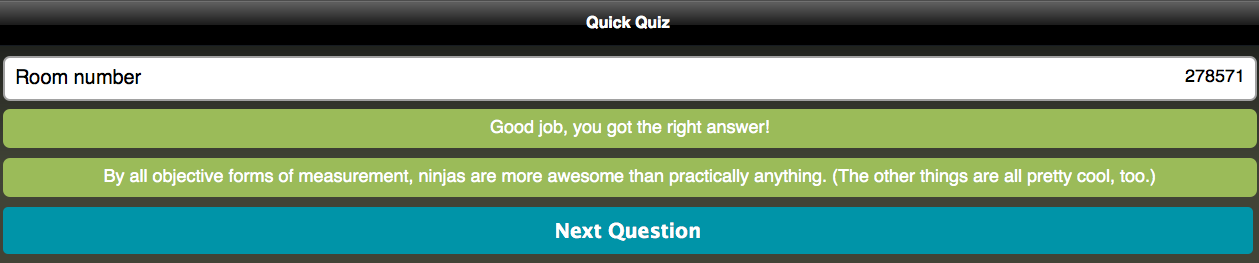
Now, while students are taking the quiz, the teacher can use their end of the software to monitor progress and results in real time:

Free-response questions can also be built into a Socrative quiz. Here's an example from the quiz from the staff meeting:

Now, obviously I use this in a far more practical manner in the classroom. (That's not to say that questions about ninjas and ice cream aren't important, BECAUSE THEY ARE.) For instance, here is the warm-up question I administered to my students this morning:

Now, here's the really cool part.
When I see that the students have finished, I end the activity. Then, I am presented with the option to e-mail a report to myself.

So this morning when my students finished their warm-up question, I had a report e-mailed to me. A few minutes later, this arrived in my inbox (student names have been removed):

Formative performance data that can inform and drive my classroom instruction to best meet the needs of my students? All organized and color-coded in an Excel spreadsheet? And this software is free? HOLY CRAP. YES PLEASE.
But wait! There's more!
If you don't have time to write a quiz in Socrative, that's no problem at all. Socrative also allows for a quick one-question option that allows you to assess students on the fly.
On the teacher control panel, you can choose to start a quick multiple choice, true/false, or short answer activity:
You can announce the question orally, or provide it in a written format on paper, dry erase board, online LMS, napkin, ankle tattoo, whatever. Say you wanted to do a true/false question. You select this option, and the students see this on their screen:

Notice that there's no question displayed. As I mentioned, it's up to you to present the question however you want. The point is that you can use Socrative on the fly to formatively assess your students as well. You can also monitor results in real time, though there won't be names attached (so this is also good for taking an anonymous poll). The downside, however, is that you can't e-mail a report to yourself in this mode.
So far, I'm seeing great advantages to using Socrative in my classroom. It's a very handy way for me to quickly collect and organize formative assessment data before, during, and after a lesson. It allows me to more effectively monitor my students' learning and to make appropriate instructional decisions. And, since Socrative can be downloaded as an app to mobile devices, it's also conducive to a BYOT classroom environment.
Probably the one thing I really wish Socrative could do is recognize math type. In the slope question above, I had to settle for typing "1/3" and "5/6" instead of putting them into a less-confusing vertical format. There's also no way to insert charts, graphs, tables, etc. There are ways to get around this, of course. (I can post the full question in another medium that supports math-type and have the students submit their responses via Socrative.) Still, it would be convenient to have these features present. (EDIT 8/22/2013: In the past year since this post was written, Socrative has added the ability to post images. This provides another way around the issue. Sweet!)
Overall, this is a great piece of software and is a very simple way of recording formative assessment data. Works great in a 1:1 technology environment, provides real-time results, and supports data-driven instructional practice. I give it four out of five ninjas.
RATING:
(Trust me, there are four ninjas next to "RATING:" here. You can't see them, because they're ninjas.)
Subscribe to:
Posts (Atom)